
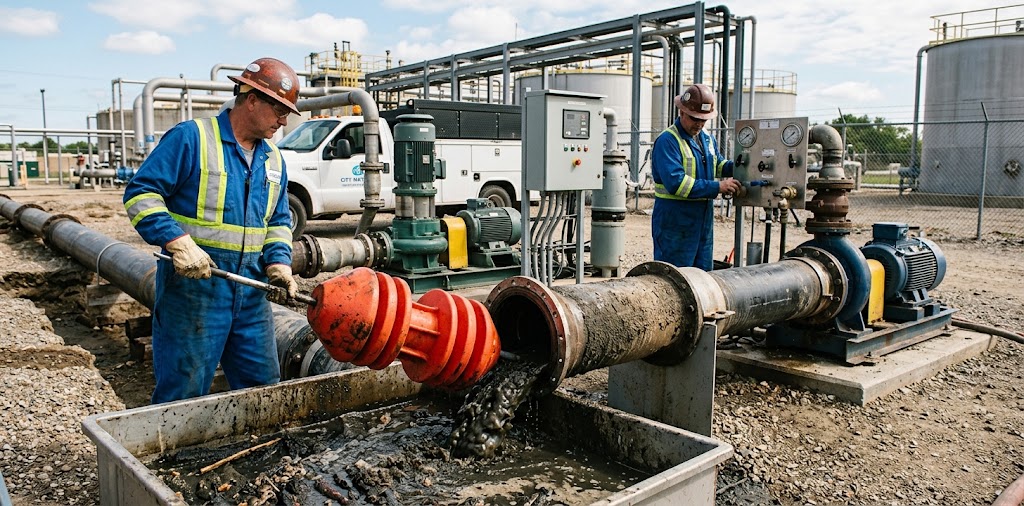
A wastewater force main depends on pumps to move sewage from a lift station to a discharge point or treatment facility. When grease, sediment, biofilm, and other material accumulate inside the pipe, the system may gradually lose hydraulic capacity.
Force main pigging can remove suitable deposits and restore more of the available flow area. When internal buildup is causing excessive resistance, cleaning may increase flow, reduce pump runtime, and improve the amount of wastewater moved for each unit of electricity consumed.
What Is Force Main Pigging?
Force main pigging is a pipeline cleaning process that moves a foam, polyurethane, mechanical, or pumpable cleaning medium through a pressurized wastewater line. The cleaning medium contacts the internal wall and transports loosened material toward a planned receiving point.
Unlike a gravity sewer, a force main relies on mechanical pumping. Its internal condition therefore affects the resistance the pump must overcome whenever wastewater moves through the system.
Cleaning is only one part of water main and wastewater pipeline maintenance. Pumps, valves, air release equipment, controls, pipe condition, and downstream restrictions must also be considered when performance declines.
Why Force Mains Lose Flow Capacity
Force mains carry wastewater containing suspended solids, grease, organic material, grit, and dissolved minerals. Some of this material can settle, adhere to the wall, or combine with other deposits.
Several forms of buildup may be present within the same pipeline.
Fats, Oils And Grease
Fats, oils, and grease can coat the pipe wall and capture additional solids. The resulting layer may become thicker and more cohesive as material continues to pass through the force main.
Sediment And Grit
Heavy particles may settle during low flow periods or extended pump shutdowns. Low points, oversized pipe sections, and areas with inadequate velocity can be particularly susceptible to accumulation.
Biofilm And Organic Material
Microorganisms can form a layer of biological material along the internal surface. Pipeline biofilm removal may require physical cleaning when circulation or routine flushing does not provide sufficient wall contact.
Mineral And Corrosion Deposits
Struvite, mineral scale, and loose corrosion products can also restrict a force main. Hard or strongly attached deposits may require a more aggressive method than the one selected for soft grease, sediment, or biofilm.
How Deposits Affect Force Main Hydraulics
A force main must provide enough flow area while limiting friction along the pipeline. Internal deposits can change both conditions, even when wastewater continues moving through the system.
Buildup occupies part of the bore, leaving less space for flow. It can also create a rougher surface that increases resistance as wastewater travels toward the discharge point.
This additional friction contributes to total dynamic head. The pump may then deliver less flow at its existing operating point, run longer to lower the wet well, or require more power to satisfy the operating demand.
Cleaning can reduce the friction component of system head when deposits are responsible for the restriction. It cannot change the static elevation between the pump station and the force main outlet.
Pump Efficiency Versus Pumping System Efficiency
Force main pigging does not rebuild a worn pump or improve motor efficiency directly. Instead, it may reduce resistance in the connected pipeline so the complete pumping system operates more effectively.
Depending on the system design and pump controls, successful cleaning may provide:
- Higher flow at a comparable pump speed
- Lower discharge pressure at a required flow rate
- Faster wet well drawdown
- Shorter pump cycles
- More wastewater moved per kilowatt hour
- Greater capacity during peak inflow
The outcome depends on the original deposit loading, static head, pump curve, valve positions, pump condition, and control settings. If the force main was already clean, pigging is unlikely to correct a problem caused by impeller wear, air binding, a failed valve, or unsuitable pump selection.
Signs A Force Main May Need Cleaning
Performance deterioration often develops gradually. The pump station may compensate for increasing pipeline resistance before operators recognize that the force main has lost capacity.
Possible warning signs include:
- Flow below historical operating levels
- Increasing pump discharge pressure
- Longer or more frequent pump cycles
- Slower wet well drawdown
- Higher energy use per volume pumped
- Difficulty managing peak wastewater inflow
- Repeated high wet well or pressure alarms
- Known grease, grit, or mineral accumulation
- Declining performance despite functional pumps
These symptoms do not confirm that cleaning is required. Operators should investigate the pump station and pipeline before selecting a corrective method.
Is The Problem In The Pump Or The Pipeline?
Low flow can result from pump wear, blocked impellers, incorrect speed, check valve problems, air pockets, partially closed valves, or downstream restrictions. Cleaning the force main will not resolve these mechanical or operational faults.
Troubleshooting should compare actual pump performance with historical data and the expected pump curve. Flow, discharge pressure, wet well levels, pump speed, runtime, valve positions, and electrical consumption should be reviewed together.
Pressure readings taken at several points can help determine whether resistance is spread throughout the line or concentrated in one area. Previous cleaning records, wastewater characteristics, pipeline geometry, and deposit samples can provide additional evidence.
This assessment helps operators determine whether cleaning should be considered before installing larger pumps. Adding pumping power without removing a confirmed pipeline restriction may increase energy use while leaving the underlying problem in place.
Force Main Pigging Methods
The deposit, pipe configuration, access, pressure limits, and required result determine which cleaning method fits the project. Some force mains can accept conventional pigs, while others need a more flexible approach.
Foam And Polyurethane Pigging
Foam and polyurethane pigs are inserted through a launcher and driven through the force main using water or pipeline pressure. Different densities, coatings, discs, or brushes can provide varying levels of cleaning action.
The pipeline must offer a continuous piggable route. Bends, valves, branches, diameter changes, internal restrictions, and receiving access must be evaluated before the pig enters the line.
Progressive Pigging
Progressive pigging uses a sequence of pigs that gradually increase in size or cleaning force. This approach can reduce the risk of pushing a large volume of debris into one concentrated blockage.
Each run requires pressure control, tracking, receiving arrangements, and debris management. A recovery plan is also necessary if a mechanical pig stops inside the force main.
Ice Pigging
Ice pigging uses a pumpable ice slurry that forms a flexible cleaning plug inside the pipe. The slurry contacts the wall, loosens suitable grease, sediment, biofilm, grit, and soft deposits, then carries the material toward the discharge point.
The difference between ice pigging and conventional pigging is particularly relevant for force mains with bends, valves, fittings, or changes in diameter. Ice can alter its shape as it moves and can melt if movement stops, reducing the risk of a rigid object remaining trapped.
How A Force Main Pigging Project Is Planned
Cleaning must be planned around the complete force main and pump station. The project team reviews drawings, pipe material, diameter, length, route, valves, branches, high points, access, operating pressure, and suspected deposits.
The plan must also address incoming wastewater while the line is isolated. Adequate wet well storage or bypass pumping may be required to prevent an overflow or interruption elsewhere in the collection system.
Suitable insertion and receiving points are then selected. During cleaning, pressure and flow must remain within established limits, while the pig or slurry movement is monitored along the route.
Removed grease, solids, and wastewater should be captured at the outlet. Allowing the material to enter another sewer section without control may simply transfer the restriction downstream.
After cleaning, the force main is flushed, operating equipment is restored, and the system is checked before returning to normal service.
How To Measure Pigging Results
Reliable measurement begins before cleaning. Baseline readings should be collected under known operating conditions so the postcleaning test can be performed using the same pump arrangement, speed, valve positions, and wet well levels.
Useful measurements include:
- Flow rate
- Pump discharge pressure
- Wet well drawdown time
- Pump runtime
- Electricity consumed
- Energy per volume pumped
- Peak pumping capacity
- Quantity and type of material removed
Energy per unit volume is usually more informative than total electricity use. A pump station handling more wastewater after cleaning could consume more total power while still operating more efficiently.
Changes to pumps, controls, valves, or downstream conditions must be documented. If pump repairs and pipeline cleaning happen together, the full improvement cannot be attributed to force main pigging alone.
A defensible approach to measuring ice pigging results connects baseline data, discharge evidence, hydraulic testing, and agreed acceptance criteria.
Where Ice Pigging Fits Into Force Main Maintenance
Ice pigging may be considered when flushing is not providing sufficient physical cleaning, conventional launcher and receiver facilities are unavailable, or rigid pigging presents unacceptable operational challenges.
The Ice Pigging™ team assesses pipe dimensions, material, route, bends, branches, valves, access points, pump capacity, pressure, deposits, isolation requirements, wastewater storage, discharge handling, and the permitted maintenance window.
The wider range of ice pigging applications includes suitable wastewater lines affected by fats, oils, grease, grit, biofilm, soft solids, and mineral deposits. Each project is evaluated individually because deposit conditions and force main configurations vary significantly.
Ice pigging cannot repair structural damage, stop active corrosion, restore lost wall thickness, or correct poor hydraulic design. It also does not replace pump maintenance, force main inspection, air valve servicing, or leak detection.
Frequently Asked Questions
The answers below address common questions about force main cleaning and hydraulic performance. Project requirements should always be based on the actual pipeline and pump station.
Does Force Main Pigging Increase Flow?
Pigging may increase flow when deposits are reducing the effective diameter or increasing internal friction. The amount of recovery depends on the condition of the force main before cleaning.
Can Pigging Reduce Pump Runtime?
Cleaning may shorten runtime when excessive cycles are caused by pipeline resistance. Comparable wet well levels, pump speeds, and incoming wastewater volumes are needed to verify the change.
How Often Should A Force Main Be Pigged?
There is no universal interval. Flow, pressure, pump runtime, energy use, deposit loading, wastewater characteristics, and previous cleaning results should guide the schedule.
Can Ice Pigging Remove Grease And Biofilm?
Ice pigging can help remove suitable grease, biofilm, sediment, grit, and soft deposits from compatible force mains. Deposit type, thickness, access, and operating conditions must be reviewed first.
Does Force Main Pigging Inspect The Pipe?
Cleaning removes deposits but does not provide a complete structural inspection. Separate inspection or condition assessment may be necessary to evaluate wall loss, cracks, leaks, joints, or other defects.
Restore Capacity Before Adding More Pumping Power
Force main pigging can recover hydraulic capacity when internal buildup is creating unnecessary resistance. The strongest results come from diagnosing the cause, selecting the right cleaning method, controlling the work, capturing removed material, and comparing performance under repeatable conditions.
Operators can share force main drawings, pump information, flow and pressure data, access points, suspected deposits, and maintenance requirements with the Ice Pigging™ team. A feasibility assessment can determine whether physical ice slurry cleaning fits the pipeline and the wider maintenance program.