
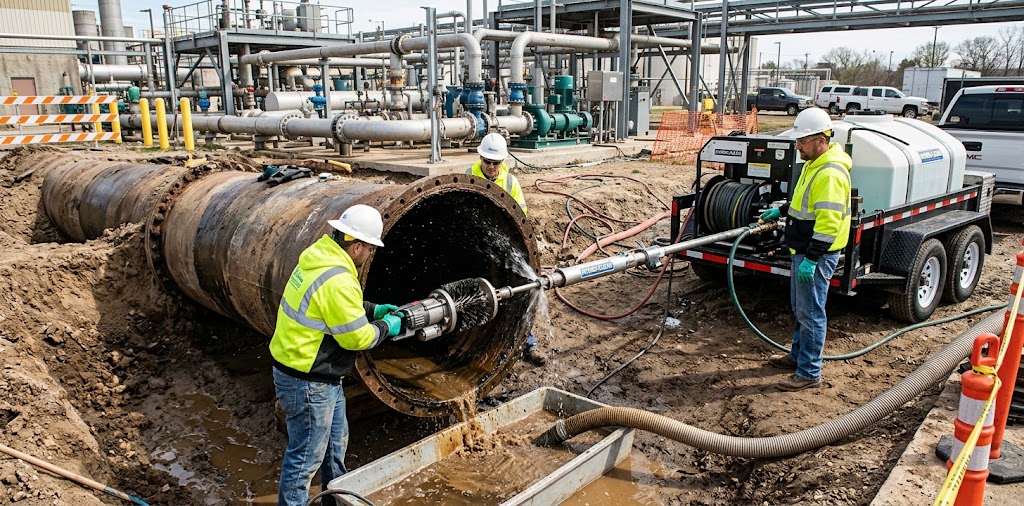
Removing established biofilm usually requires more than opening a flushing point or adding disinfectant. The attached material must be disrupted, transported out of the pipeline, and followed by appropriate rinsing, disinfection, testing, and system restoration.
The correct approach depends on the pipeline’s purpose, material, diameter, configuration, operating fluid, contamination level, and acceptance requirements. A potable water main, cooling loop, wastewater force main, and food processing line should not share one generic cleaning specification.
What Is Pipeline Biofilm?
Biofilm forms when microorganisms attach to an internal pipe surface and develop a protective matrix. This matrix may contain bacteria, organic material, mineral particles, sediment, and corrosion products.
The protective layer can make attached microorganisms more difficult to reach with disinfectants than organisms suspended in water. Biofilm may also trap material that contributes to water quality changes, recurring contamination, restricted flow, or increased maintenance.
Finding biofilm does not automatically mean drinking water is unsafe. Its significance depends on the organisms present, water quality results, system conditions, and applicable utility requirements.
Biofilm, Scale And Sediment Need Different Responses
Not every dark, soft, or discolored deposit is biofilm. Pipelines often contain several forms of buildup at the same time, and each may respond differently to cleaning.
Sediment consists mainly of loose particles that may settle in low flow areas. Mineral scale forms harder deposits, while corrosion can produce iron oxide, tuberculation, and rough internal surfaces. Grease and product residue may coat industrial pipelines and support further microbial growth.
Testing or analyzing removed material can help determine whether the problem is primarily microbial, mineral, organic, or corrosion related. This distinction prevents operators from selecting a cleaning method based only on appearance.
Confirm The Problem Before Cleaning
A biofilm investigation should begin with the operating problem. Recurring microbial results, declining disinfectant residual, slime found during inspection, rising differential pressure, repeated strainer blockage, product contamination, or reduced heat transfer may justify further assessment.
Bulk water samples provide useful information, but they represent the water at one point and time. They do not describe every internal surface or show how strongly material is attached.
Depending on the system, the assessment may include microbial samples, ATP screening, deposit analysis, coupons, borescope inspection, turbidity trends, corrosion data, flow measurements, and maintenance history. Operators should also define the required result before selecting a cleaning method.
Why Flushing And Disinfection May Not Be Enough
Flushing, physical cleaning, and disinfection perform different functions. Effective biofilm remediation may require all three, but the sequence must be planned around the system.
Flushing Moves Water And Loose Material
Conventional flushing exchanges water and can carry loose sediment from a pipeline. Unidirectional flushing uses planned valve operation to create a controlled flow path and higher velocity through a selected section.
Results depend on the available flow, pipe diameter, deposit strength, valve condition, and discharge arrangement. Some flushing programs remove loose material effectively, while others mainly replace stagnant water or redistribute deposits.
The comparison between ice pigging and water flushing explains why direct contact with the internal surface may be needed when repeated flushing produces limited improvement.
Disinfection Targets Microorganisms
Chemical disinfection is intended to reduce viable microorganisms. Its performance depends on the chemical selected, concentration, contact time, temperature, pH, organic demand, circulation, and biofilm condition.
A disinfectant may kill exposed organisms without removing the complete protective matrix. Heavy biofilm can also consume treatment chemicals before the required concentration reaches every part of the system.
Chemical selection and dosing must follow applicable regulations, manufacturer guidance, material compatibility requirements, and site safety procedures. Universal chemical concentrations should not be applied across unrelated pipeline systems.
Physical Cleaning Detaches Attached Material
Physical cleaning uses contact, wall shear, or focused mechanical energy to disrupt material attached to the pipe. The released biofilm must then be transported to a controlled receiving point rather than sent into valves, filters, heat exchangers, or production equipment.
This distinction is important. A successful cleaning plan must explain not only how deposits will be loosened, but also where they will travel and how they will be collected.
Methods Used To Remove Pipeline Biofilm
No method is suitable for every pipeline. Operators should compare the cleaning objective with the pipe geometry, deposit type, available access, pressure limits, downtime, and consequences of incomplete removal.
Common options include:
- Unidirectional flushing for loose material in suitable water distribution systems
- Air scouring where controlled air and water movement can increase cleaning action
- Foam swabbing or conventional pigging for compatible, piggable pipelines
- Ice pigging for suitable systems with bends, fittings, valves, or diameter changes
- Water jetting where direct access and concentrated cleaning energy are available
- Chemical cleaning or CIP for compatible industrial and hygienic systems
- Thermal sanitization for systems designed to tolerate and distribute heat
- Enzymatic cleaning for specific organic matrix components and operating conditions
Mechanical pigs provide direct contact but normally require a route that the selected pig can navigate safely. Jetting can deliver concentrated energy, although access, hose reach, pressure, wastewater, and internal lining condition must be considered.
Chemical, thermal, and enzymatic methods require careful control. Compatibility with pipes, linings, seals, valves, instruments, products, and downstream treatment must be confirmed before work begins.
How Ice Pigging Removes Biofilm
Ice pigging uses a pumpable mixture of ice crystals and liquid that behaves like a deformable cleaning plug. Controlled pressure moves the slurry through the pipeline, where it contacts the internal wall and carries loosened material toward a receiving point.
Because the slurry conforms to many bends, fittings, valves, and diameter changes, it can be considered where water flushing provides insufficient contact or rigid pigging presents routing concerns. The ice can also melt if movement stops, reducing the risk of leaving a solid cleaning tool inside the pipe.
Ice pigging is a physical cleaning process. It does not sterilize the pipeline or replace disinfection, water treatment, corrosion control, or a validated sanitation program.
The service may be evaluated for suitable water mains and wastewater pipelines as well as industrial process lines. Feasibility depends on the route, access points, deposit condition, available pressure, isolation, discharge capacity, and return to service requirements.
A Practical Biofilm Removal Process
A controlled project begins before cleaning equipment reaches the site. The complete sequence should connect the suspected problem with measurable acceptance criteria.
A typical plan may include:
- Identify the affected route and operating concern
- Analyze the deposit and existing water or process data
- Define required cleanliness and microbial results
- Review pipe materials, fittings, access, and pressure limits
- Isolate the cleaning route and protect connected equipment
- Apply the selected physical or chemical treatment
- Capture and assess discharged material
- Flush, rinse, neutralize, or disinfect as required
- Complete final testing and restore the system
- Monitor performance for signs of regrowth
The order may change for mixed deposits. Chemical treatment might soften resistant material before physical removal, while another system may require physical cleaning before final disinfection.
Potable Water And Industrial Systems Require Different Plans
Potable water main cleaning must follow utility procedures and applicable regulatory requirements. Planning may include public notification, cross connection control, potable water handling, discharge management, disinfection, bacteriological sampling, and formal authorization before service is restored.
Industrial systems introduce different concerns. A cooling loop may prioritize differential pressure, heat transfer, and fluid chemistry. Food and beverage facilities may require product compatibility, allergen controls, microbial validation, and coordination with existing CIP procedures.
Physical removal can complement food and beverage pipeline cleaning, but it does not automatically replace validated cleaning or sanitation. Pharmaceutical, cosmetic, chemical, wastewater, and energy systems also require criteria suited to their products, hazards, and operating standards.
How To Verify Biofilm Removal
Completing a cleaning pass does not prove that the original objective was achieved. Verification should be defined before work begins and connected to the problem that triggered cleaning.
Useful evidence may include discharge samples, turbidity, recovered solids, deposit composition, ATP results, microbial testing, flow, differential pressure, strainer loading, borescope inspection, water quality, or product testing.
The guide to measuring ice pigging results explains why process readings, removed material, and post-cleaning performance must be interpreted together. No single sample confirms that every internal surface is completely free from biofilm.
How To Reduce Biofilm Regrowth
Cleaning removes accumulated material but does not correct the conditions that allowed it to develop. Biofilm can return if the pipeline continues to experience stagnation, excessive water age, low circulation, nutrient availability, poor temperature control, or inadequate microbial management.
Operators should investigate dead legs, unused branches, failing filters, storage tanks, corrosion, rough internal surfaces, and inconsistent disinfectant residual. An ongoing program may combine monitoring, circulation management, water treatment, scheduled cleaning, and equipment maintenance.
Cleaning also cannot restore lost pipe wall thickness, repair damaged lining, or stop microbiologically influenced corrosion by itself. Severely deteriorated or poorly designed sections may require repair, relining, redesign, or replacement.
How The Ice Pigging™ Team Plans Biofilm Removal
Every proposed cleaning route requires a technical review. The Ice Pigging™ team assesses pipe material, diameter, length, bends, branches, valves, operating fluid, pressure, access points, deposit information, isolation requirements, and discharge arrangements.
The project plan also considers the required maintenance window, connected equipment, verification method, and conditions for returning the pipeline to service. This determines whether ice pigging is suitable and how it should fit within the operator’s wider cleaning and microbial control program.
The ice pigging process includes pipeline review, site setup, controlled slurry injection, discharge handling, flushing, and final verification. Share your drawings, pipe dimensions, fluid details, access points, test results, and cleaning objectives to request a project specific feasibility assessment.
Frequently Asked Questions
Biofilm removal requirements vary between potable water, wastewater, cooling, and process pipelines. These answers address the most common planning questions.
Can Flushing Completely Remove Pipeline Biofilm?
Flushing may remove loose biofilm and sediment when sufficient velocity and controlled flow are available. Mature or strongly attached biofilm may require greater physical contact or another cleaning method.
Does Chlorine Remove Biofilm From Water Pipes?
Chlorine can inactivate susceptible microorganisms, but established biofilm may limit penetration and consume disinfectant. Treatment must follow system specific concentration, contact time, water chemistry, and regulatory requirements.
Can Ice Pigging Sterilize A Pipeline?
No. Ice pigging physically removes deposits from suitable pipe surfaces. Required disinfection, sanitation, sampling, and microbial control remain separate parts of the complete program.
How Is Biofilm Removal Verified?
Verification may include discharge analysis, ATP testing, microbial samples, turbidity, recovered solids, inspection, flow, differential pressure, and post-cleaning performance. The correct measures depend on the original objective.
Can Biofilm Cause Pipeline Corrosion?
Biofilm may contribute to conditions associated with microbiologically influenced corrosion, but corrosion can have several interacting causes. Cleaning should be combined with material, chemistry, and corrosion assessment.
How Often Should Pipelines Be Cleaned?
There is no universal interval. Cleaning frequency should reflect monitoring results, deposit accumulation, operating conditions, water quality, product requirements, maintenance history, and the consequences of fouling.
Remove The Deposit And Address The Cause
Effective biofilm remediation requires more than treating the water. Operators must identify the deposit, choose a compatible removal method, collect the released material, complete required disinfection and testing, and address the conditions that encourage regrowth.
A project specific plan produces stronger evidence, protects connected equipment, and gives operators a defensible basis for returning the pipeline to service.