
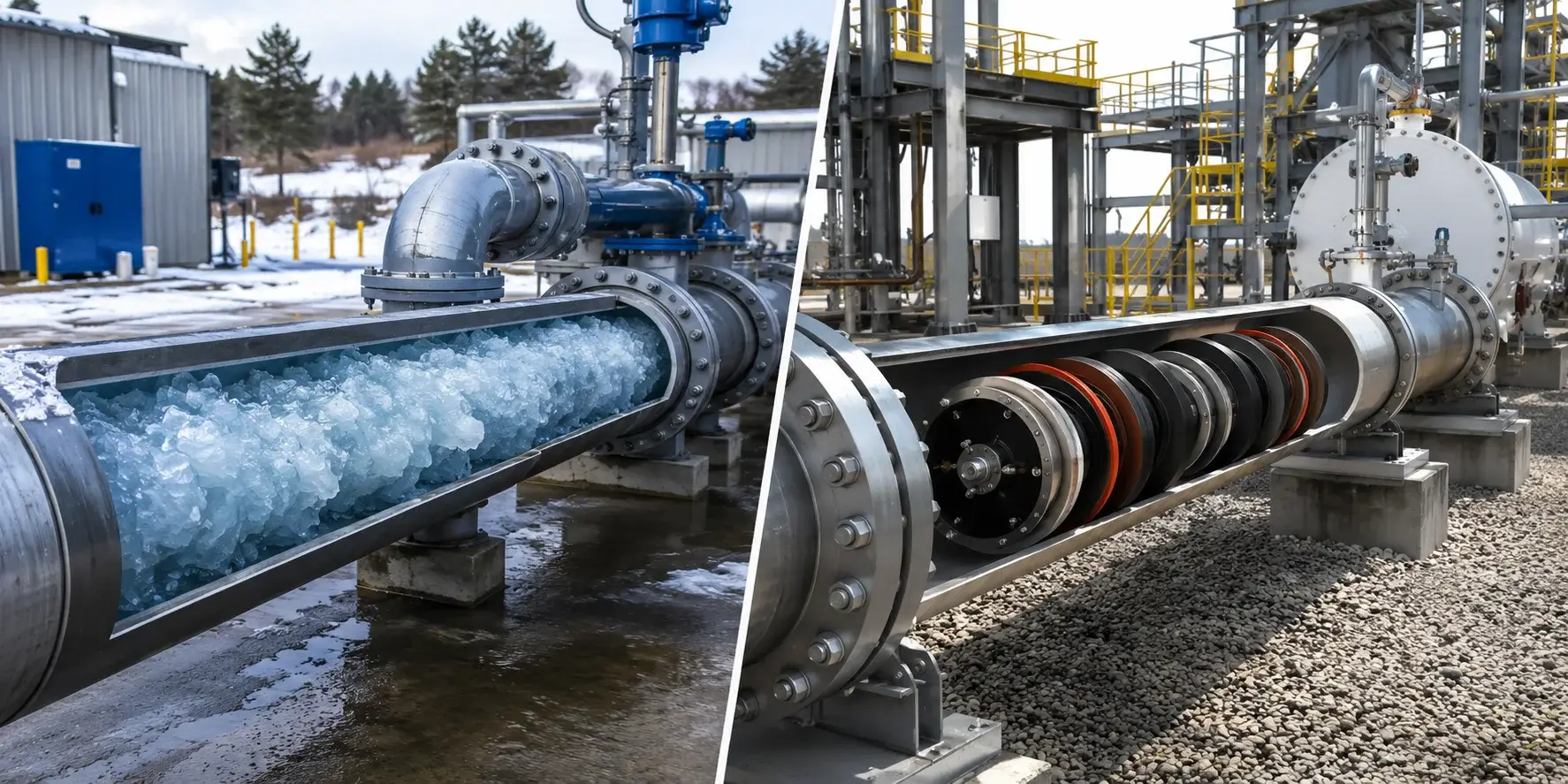
Ice pigging and conventional pigging both clean pipelines, but they work in very different ways. Ice pigging uses a pumpable ice slurry that conforms to the pipe, while conventional pigging sends a solid or foam device through the line.
Ice pigging often suits moderate buildup, complex layouts, and pipelines without permanent launchers. Conventional pigging is generally stronger for long piggable pipelines, hardened deposits, dewatering, product separation, and internal inspection.
Ice Pigging Vs Conventional Pigging At A Glance
| Comparison Factor | Ice Pigging | Conventional Pigging |
|---|---|---|
| Cleaning Medium | Semi-solid ice slurry | Solid or foam pig |
| Typical Access | Existing fittings where suitable | Launcher and receiver |
| Pipe Geometry | Adapts to many bends and size changes | Requires confirmed piggability |
| Best Deposits | Biofilm, sediment, grease, and soft residue | Hardened scale, heavy debris, and thick buildup |
| Stalled Pig Response | Ice can melt and be flushed out | Mechanical recovery may be required |
| Inspection Capability | Cleaning and discharge verification | Smart pigs can inspect pipe condition |
| Best Fit | Complex utility and process systems | Long, uniform, piggable pipelines |
Neither method is automatically better. The right choice depends on pipe geometry, buildup type, access, operating conditions, downtime limits, and the project objective.
What Is Ice Pigging?
Ice pigging uses a dense mixture of ice crystals and liquid to form a flexible cleaning plug inside a pipeline. The slurry moves like a thick fluid during injection, then creates solid-like contact against the internal pipe wall.
This pumpable ice slurry helps lift sediment, biofilm, grease, loose scale, and product residue before carrying the material toward a planned discharge point.
Because the slurry can change shape, it can move through many bends, valves, fittings, and changes in diameter. If movement stops, the ice can soften and melt, reducing the risk of permanent blockage.
What Is Conventional Pigging?
Conventional pigging sends a self-contained device through a pipeline for cleaning, drying, gauging, product separation, or inspection. The term covers several pig designs rather than one single tool.
Foam pigs are commonly used for light cleaning and drying. Cup, disc, brush, and scraper pigs create stronger mechanical contact, while smart pigs carry instruments that assess corrosion, dents, pipe geometry, and wall thickness.
Most free-running pigs are inserted through a launcher and removed through a receiver. These systems may already be part of the pipeline or may need to be installed for the project.
How The Cleaning Action Differs
Both methods contact the pipe wall, but the form and strength of that contact differ. Ice slurry conforms to the available space, while a conventional pig relies on cups, discs, brushes, or scrapers sized for the pipeline.
Ice Slurry Wall Contact
Ice slurry provides broad wall contact while remaining flexible. It is particularly useful for sediment, biofilm, grease, soft deposits, and product residue.
Its ability to deform also makes it practical in systems where bends, valves, fittings, or changing pipe diameters create challenges for rigid tools.
Mechanical Scraping Force
Conventional pigs can deliver stronger mechanical force. Brush and scraper pigs are generally better suited to hardened scale, thick wax, heavy debris, and strongly attached industrial buildup.
Ice pigging therefore often fits moderate deposits and complex systems, while conventional pigging remains valuable when aggressive mechanical cleaning is required.
Setup And Access Requirements
Ice slurry can often be introduced through suitable hydrants, valves, fittings, drains, or process connections. The line still needs a controlled entry point, planned outlet, suitable isolation, and discharge strategy.
Conventional pigging typically requires launcher and receiver access. Where that infrastructure is not available, the project may need excavation, fabrication, pressure controls, or additional preparation.
Pipe condition, pressure, isolation, access points, and discharge requirements shape the full pipeline cleaning sequence before slurry or a mechanical pig enters the line.
Pipe Geometry And Piggability
Ice pigging has an advantage in many pipelines with bends, valves, fittings, and diameter changes because the slurry can alter its shape. It cannot pass through every restriction, so the complete route must still be reviewed.
Conventional pigs can also navigate bends and changes in diameter when designed for those conditions. Their performance depends on bend radius, tees, valve types, branch connections, internal restrictions, and launcher or receiver access.
Pipelines with tight bends, major bore changes, unsuitable valves, or unbarred tees may require modification or a specially designed pig.
Stuck-Pig Risk And Recovery
An ice pig has a lower permanent entrapment risk because it can melt if movement stops. Operators may pause the operation, allow the slurry to soften, and then flush or drain it from the line.
A conventional pig that stalls may need to be located and recovered through pressure changes, flow reversal, retrieval work, or excavation. Tracking transmitters can help operators determine its position.
Correct sizing, pipeline surveys, proving runs, and suitable pig selection reduce this risk. They do not make every pipeline suitable for conventional pigging.
Pipe Size Run Length And Inspection
Conventional pigging generally has the advantage on long, large-diameter pipelines with consistent geometry and established pigging infrastructure. It can also support drying, dewatering, gauging, product separation, and inspection.
Ice pigging is often attractive for small to medium utility mains, shorter complex sections, and industrial process piping. Longer networks may be divided into several planned cleaning runs.
Inspection is one of the clearest differences. Ice pigging can provide discharge observations, pressure records, samples, and before-and-after measurements, but it cannot carry the instruments used by a smart pig.
When the main objective is identifying corrosion, cracks, dents, or wall loss, conventional inline inspection is the more appropriate method.
Water Use Downtime And Cost
Ice pigging requires water for slurry preparation, movement, and final flushing. Its direct wall contact can reduce repeated high-volume flushing, although actual use depends on pipe dimensions, deposit load, slurry volume, and site conditions.
Water requirements for conventional pigging vary according to the pig type and operating medium. A fair comparison should include propulsion, flushing, sanitation, discharge handling, and the number of passes required.
Ice pigging may require less setup where suitable access points already exist. Conventional pigging can be highly efficient when the pipeline has permanent launchers, receivers, and proven operating procedures.
Fewer repeat passes, simpler access, and reduced disruption are among the main operational advantages for suitable ice pigging projects.
Which Method Fits The Pipeline?
Ice pigging is often a strong option for:
- Biofilm, sediment, grease, and soft product residue
- Complex utility or process pipework
- Pipelines without permanent launchers and receivers
- Systems where lengthy shutdowns are difficult
- Routine cleaning of suitable water and wastewater lines
Conventional pigging is often better for:
- Hardened scale, thick wax, and heavy industrial buildup
- Long, consistently piggable transmission pipelines
- Dewatering, drying, gauging, or product separation
- Smart pigging and integrity inspection
- Pipelines already equipped with pigging infrastructure
The methods can also complement each other. A mechanical pig may remove heavy deposits before ice slurry completes residual cleaning, or ice pigging may maintain a line between larger conventional campaigns.
Ice Pigging For U.S. Pipeline Systems
IcePigging.com helps utilities, municipalities, and industrial operators assess ice slurry cleaning for drinking water mains, wastewater force mains, process piping, and heating or cooling networks.
The method can support water, wastewater, and industrial pipelines when the buildup, access points, pipe geometry, and operating conditions match the technology.
Every project should begin with a review of pipe diameter, length, material, route, isolation, pressure, discharge requirements, and the material being removed.
Frequently Asked Questions
Is Ice Pigging Better Than Conventional Pigging?
Neither method is always better. Ice pigging often suits moderate deposits and complex geometry, while conventional pigging is stronger for heavy buildup, long runs, and internal inspection.
Can Ice Pigging Remove Hardened Scale?
Ice pigging may remove loose scale, but heavily cemented deposits often require mechanical cleaning, chemical treatment, or pipeline rehabilitation.
Does Conventional Pigging Always Need A Launcher And Receiver?
Most free-running conventional pigs need suitable launching and receiving arrangements. Temporary systems may be installed where permanent infrastructure is unavailable.
Can Ice Pigging Pass Through Bends And Valves?
Ice slurry can pass through many bends, fittings, full-bore valves, and diameter changes. The route still needs to be checked for restrictions and unsuitable components.
Which Method Uses Less Water?
Ice pigging often uses less water than repeated flushing. A direct comparison with conventional pigging depends on the operating medium, number of passes, discharge plan, and final flushing requirements.
Choosing The Right Pigging Method
Ice pigging and conventional pigging solve different pipeline problems. Ice slurry provides flexible cleaning with lower permanent entrapment risk, while conventional pigs offer greater mechanical force and broader inspection capability.
The right decision starts with the deposit, pipe geometry, access, diameter, run length, downtime limits, and cleaning objective. A professional feasibility review can identify the safest and most practical method before work begins.