
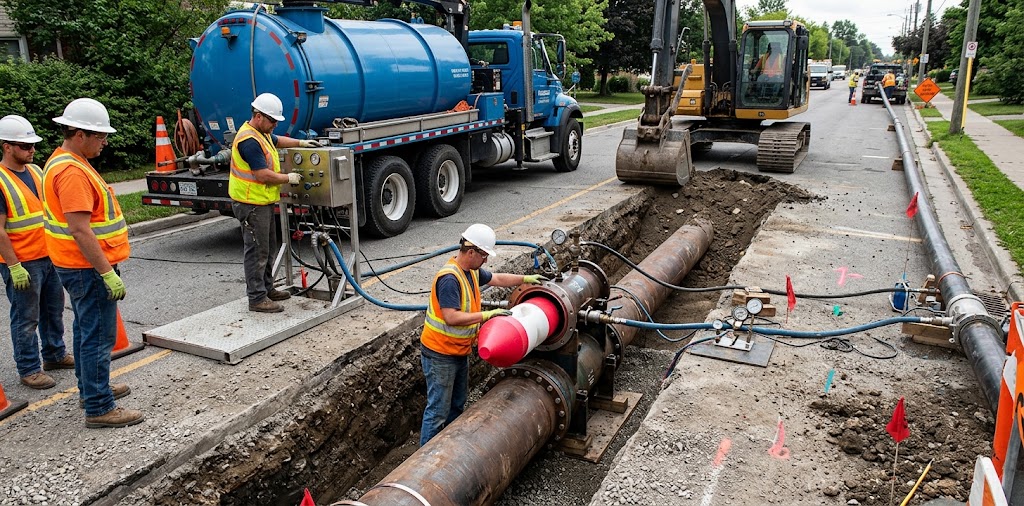
Water main pigging is a physical cleaning process used to remove sediment, biofilm, scale, corrosion products, and other deposits from distribution and transmission pipelines. A cleaning device or pumpable medium travels through an isolated section and carries removed material toward a controlled discharge point.
Pigging is not one single technique. Utilities may use foam swabs, coated mechanical pigs, brush pigs, or pumpable ice slurry depending on the deposits, pipe condition, internal geometry, access, and required cleaning result.
Why Water Mains Need Internal Cleaning
Material can enter a water main during construction, repairs, treatment, or normal distribution system operation. Other deposits develop gradually as suspended solids settle, metals oxidize, or microorganisms attach to internal surfaces.
Changes in demand, valve operation, hydrant use, or flow direction can disturb accumulated material. This may contribute to discoloration, elevated turbidity, pressure loss, or recurring customer complaints.
Sediment And Loose Debris
Sediment often settles in low-flow areas, dead ends, oversized mains, and sections with changing elevations. Construction debris, pipe scale, jointing material, and corrosion products may also remain after installation or repair.
Routine flushing can transport some loose material. Attached or compacted deposits may require stronger physical contact with the pipe wall.
Biofilm
Biofilm is a mixture of microorganisms and organic or inorganic material attached to internal surfaces. It can collect sediment, increase disinfectant demand, and contribute to unstable water-quality conditions.
Physical biofilm removal from water mains may be considered when monitoring and flushing do not adequately address the accumulation. Cleaning must remain part of a wider program that includes treatment, residual management, and system operation.
Iron, Manganese And Tuberculation
Iron and manganese deposits can contribute to red, brown, or black water when they are disturbed. Unlined iron mains may also develop tuberculation that restricts the available bore and increases hydraulic resistance.
Removing tuberculation does not stop the corrosion process or restore lost pipe wall. Aggressive cleaning may expose vulnerable metal, so lining, corrosion control, rehabilitation, or replacement may still be required.
What Is The Difference Between Pigging And Swabbing?
Pigging usually refers to moving a purpose-built cleaning device through the main using controlled water pressure. Mechanical pigs may be manufactured from foam, polyurethane, plastic, or metal and fitted with coatings, brushes, discs, or scrapers.
Swabbing generally uses a softer foam device for loose sediment, biofilm, construction debris, and soft scale. It creates more wall contact than flushing but may not remove hard tuberculation.
The available types of pipeline pigging also include gauging, inspection, product separation, and ice pigging. The tool must be selected according to the actual objective rather than treating every pig as interchangeable.
Water Main Cleaning Methods Compared
Every method applies a different level of force and requires different access. Deposit composition and pipe condition should be established before selecting the most aggressive option.
Conventional And Unidirectional Flushing
Conventional flushing opens hydrants or outlets to increase flow and carry loose material from the network. Unidirectional flushing isolates a planned route so water moves in one direction at a controlled velocity.
Flushing remains useful for routine distribution maintenance, but water alone may not provide enough wall contact to remove attached biofilm, sticky manganese, or hardened scale. The comparison between ice pigging and water flushing explains how physical contact changes the cleaning action.
Foam And Progressive Pigging
Foam pigs are available in different sizes, densities, and coatings. A soft or undersized prover pig may be used first to confirm the route and identify unexpected restrictions.
Progressive pigging increases pig size or aggressiveness over several passes. This staged approach can reduce the risk of pushing a large deposit load into one concentrated blockage.
Mechanical Pigging
Coated, brush, and scraping pigs can remove harder deposits than soft swabs. Their cups, discs, brushes, or abrasive surfaces maintain contact with the pipe wall while water pressure moves the device toward the receiver.
Mechanical pigging requires a continuous piggable route. Pipe diameter, bends, valves, branches, internal restrictions, insertion access, receiving access, propulsion pressure, and recovery arrangements must be confirmed before launch.
Ice Pigging
Ice pigging uses a pumpable mixture of ice crystals and liquid instead of a rigid device. The slurry forms a flexible cleaning plug that contacts the pipe wall and transports loosened material to the outlet.
Because the slurry can change shape, it can pass through many bends, fittings, valves, and diameter changes. If movement stops, the ice can soften and melt, reducing the risk of a permanent solid obstruction.
The detailed comparison of ice pigging and conventional pigging helps utilities evaluate geometry, access, cleaning force, water use, and entrapment risk.
Jetting, Air Scouring And Scraping
Jetting directs water against the internal surface and may suit accessible or localized deposits. Air scouring mixes air and water to create turbulence that helps suspend loose material.
Mechanical scraping provides more aggressive removal for hardened deposits or lining preparation. If scraping exposes bare metal, the main may require prompt lining or another form of corrosion protection.
How The Water Main Pigging Process Works
A successful project begins with a defined cleaning objective. The required procedure differs when the goal is sediment removal, discoloration control, flow recovery, commissioning, or surface preparation.
A typical project includes:
- Reviewing drawings, pipe material, diameter, valves, bends, branches, repairs, and available access
- Inspecting the route and confirming that the selected cleaning medium can travel through it
- Establishing baseline flow, pressure, turbidity, color, disinfectant residual, and complaint information
- Planning isolation, customer notification, temporary supply, and cross-connection controls
- Preparing insertion, receiving, containment, and disposal arrangements
- Introducing the pig or slurry and moving it under controlled pressure
- Monitoring pressure, flow, progress, and discharge conditions
- Collecting the removed material and determining whether another pass is required
- Flushing, disinfecting, sampling, and restoring the main under utility requirements
Existing hydrants, valves, fittings, or temporary connections may provide access on suitable systems. The specific arrangement depends on pipe size, network configuration, equipment, and the selected method.
Discharge planning is essential. Cleaning water may contain concentrated sediment, iron, manganese, corrosion material, microorganisms, scale, and other contaminants that require controlled collection or approved disposal.
Benefits Of Water Main Pigging
Pigging provides direct contact with the pipe wall, which can remove material that repeated flushing leaves behind. When the deposits are responsible for the problem, cleaning may improve water clarity, hydraulic capacity, or distribution-system stability.
Potential benefits include:
- Removal of sediment, biofilm, scale, and construction debris
- Reduced material available for future discoloration
- Improved flow where deposits restrict the bore
- Reduced pressure loss across a fouled section
- Preparation for inspection, lining, or rehabilitation
- More measurable deposit recovery
- Reduced reliance on repeated high-volume flushing
Results depend on the original cause. Pigging cannot correct source-water problems, inappropriate treatment, poor hydraulic design, active corrosion, damaged pipe, failed joints, or undersized infrastructure.
What Makes A Water Main Suitable For Pigging?
A feasibility review should confirm the complete route rather than relying only on nominal pipe diameter. Older distribution systems may contain undocumented repairs, reduced-bore valves, tight fittings, service connections, or changes in material.
The assessment should consider:
- Pipe material, age, condition, and lining
- Diameter, length, bends, and elevation changes
- Valve type and full opening
- Branches, tees, and service connections
- Available pressure and flow
- Entry and receiving points
- Known or suspected deposits
- Isolation and customer-supply requirements
- Stuck-pig or melt-back planning
- Discharge and return-to-service procedures
Fragile pipe, damaged lining, uncertain geometry, or severe structural deterioration may make aggressive mechanical pigging unsuitable. Cleaning should never be treated as proof that the main is structurally sound.
How Water Main Pigging Results Are Verified
A container of dirty discharge confirms that material left the pipeline, but it does not prove that every project objective was achieved. Verification should be agreed before cleaning begins.
Relevant evidence may include turbidity, color, iron, manganese, disinfectant residual, bacteriological results, recovered solids, final flow, pressure, fire-flow capacity, and complaint trends. Utilities should compare final readings with a reliable baseline collected under similar operating conditions.
The approach to measuring ice pigging results also distinguishes temporary discharge contamination from final water quality. Turbidity may rise during cleaning because deposits are leaving the main, while return-to-service testing must confirm that the water meets the owner’s acceptance requirements.
Where Ice Pigging Fits Into Water Main Cleaning
Ice Pigging™ provides controlled physical cleaning without sending a permanent rigid object through the selected route. It may be assessed for potable distribution mains, trunk mains, transmission pipelines, dead ends, low-flow sections, and newly installed or repaired pipework.
The water main ice pigging service is planned around pipe dimensions, material, route, deposits, water temperature, access, pressure, isolation, discharge, verification, and the available maintenance window.
During the ice pigging process, slurry is introduced through a suitable access point and moved through the main under controlled flow. Removed material exits with the ice at a prepared receiving point, after which the main is flushed, tested, and restored.
Ice pigging does not inspect wall thickness, repair leaks, restore damaged lining, stop corrosion, or replace disinfection. Its role is to remove suitable internal deposits as part of a broader water-main maintenance program.
Utilities can share drawings, pipe dimensions, material, access points, water-quality history, known deposits, and acceptance criteria with the Ice Pigging™ team for a project-specific feasibility assessment.
Frequently Asked Questions
Can Pigging Improve Water Pressure?
Pigging may improve pressure or flow when internal deposits are reducing the available bore or increasing friction. It will not correct an undersized main, pump problem, closed valve, leak, or other hydraulic limitation.
Is Water Main Pigging Better Than Flushing?
Pigging usually provides more wall contact and can remove deposits that water-only flushing may leave behind. Flushing remains valuable for routine maintenance, so the appropriate method depends on the material being removed and the required result.
Can A Pig Pass Through Water Main Valves?
Some pigs can pass through compatible full-bore valves, bends, and fittings. Butterfly valves, reduced openings, undocumented repairs, and unsuitable branches may obstruct a rigid pig and must be assessed beforehand.
Does Pigging Remove Tuberculation?
Brush or scraping pigs may remove tuberculation from compatible mains. The cleaned surface may require lining or corrosion protection because removing corrosion products does not stop the underlying deterioration.
Is Ice Pigging Safe For Potable Water Mains?
Ice pigging may be used in suitable potable-water systems when slurry preparation, equipment hygiene, isolation, discharge, flushing, disinfection, sampling, and return-to-service procedures meet the utility’s requirements.
How Often Should Water Mains Be Pigged?
There is no universal interval. Cleaning frequency should reflect deposit accumulation, discoloration history, water quality, pipe condition, hydraulic performance, previous results, and the consequences of service interruption.
Match The Cleaning Method To The Main
Water main pigging can provide targeted physical cleaning when sediment, biofilm, scale, or corrosion deposits remain after routine flushing. The strongest results come from identifying the deposit, assessing the complete route, selecting the right cleaning force, and defining acceptance criteria before work begins.
Cleaning is only complete when removed material has been controlled, water quality has been verified, and the main has been returned to service under the utility’s approved procedure.