
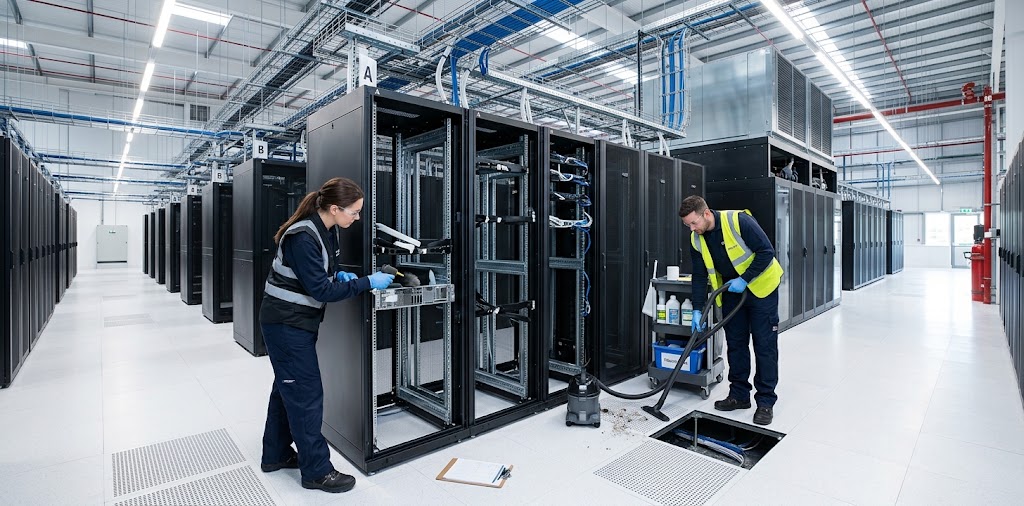
Mechanical completion does not mean a data center cooling system is ready to operate. Newly installed pipework can pass pressure testing while still containing weld residue, mill scale, metal fragments, fabrication oils, dirt, gasket material, and standing water.
Data center pre-commissioning services prepare these systems for safe startup, functional testing, and final handover. Cleaning, testing, fluid conditioning, verification, and documentation must be coordinated carefully to protect sensitive equipment and avoid preventable commissioning delays.
What Is Data Center Pre-Commissioning?
Pre-commissioning covers the inspections and activities completed after installation but before normal system startup. Its purpose is to confirm that individual systems are correctly installed, internally clean, properly filled, tested, and ready for functional commissioning.
Mechanical completion confirms that equipment and piping have been installed. Pre-commissioning prepares those assets for operation, while functional testing evaluates whether they perform as intended. Integrated systems testing later confirms how cooling, power, controls, monitoring, and backup systems respond together.
The terminology and commissioning levels may vary between owners and contractors. The approved commissioning plan should clearly identify system boundaries, responsibilities, acceptance criteria, witness points, and the documentation required at each stage.
Why Cooling System Cleanliness Matters Before Startup
Construction contamination can enter a cooling network during pipe fabrication, delivery, storage, cutting, welding, installation, and pressure testing. Open pipe ends and temporary water supplies can introduce additional material before the system is closed.
Common contaminants include:
- Weld slag and metal shavings
- Mill scale and loose corrosion products
- Fabrication oils and grease
- Dirt, dust, and jointing residue
- Gasket or sealing fragments
- Untreated standing water
- Residual cleaning chemicals
- Microbial material
Once circulation begins, loose debris can move into strainers, pumps, control valves, coils, and heat exchangers. This may cause repeated strainer blockage, restricted flow, pump damage, unstable differential pressure, fouled heat transfer surfaces, and contaminated cooling fluid.
Clean data center cooling pipelines support hydraulic balancing, equipment startup, and reliable heat transport. Pipeline cleaning does not correct poor system design or defective equipment, but it can remove internal material that would otherwise interfere with commissioning.
Cooling Systems That Require Pre-Commissioning
The correct preparation process depends on the system, cooling fluid, pipe material, connected equipment, and required cleanliness. One procedure should not be applied to every cooling circuit without a compatibility assessment.
Facility Chilled Water Systems
Facility chilled water networks may connect chillers, primary and secondary pumps, supply and return headers, heat exchangers, CRAH units, control valves, and air separators. Their size and branching can make it difficult to achieve effective flushing through every section.
Pre-commissioning may involve pressure testing, sectional flushing, filtration, physical cleaning, water treatment, filling, venting, hydraulic balancing, and fluid-quality verification. The sequence should prevent removed material from entering sensitive equipment.
Condenser Water Systems
Condenser water and cooling tower systems have greater exposure to airborne debris, mineral deposits, sediment, and biological contamination. Basin cleaning, distribution pipe flushing, water treatment, strainer inspection, and system disinfection may all be necessary.
Cleaning removes existing material but does not control the conditions that caused it. Chemistry, concentration cycles, microbial control, corrosion protection, and blowdown management require separate attention.
Glycol And Closed-Loop Systems
Closed-loop water and glycol systems require controls for fluid compatibility, concentration, corrosion inhibitors, air removal, and contamination. Any rinse water left behind can dilute the final glycol concentration or alter the intended chemistry.
The cleaning and filling procedure should identify how fluids will be recovered, tested, adjusted, and documented before the system is accepted.
Technology Cooling Systems
Technology cooling systems may include coolant distribution units, secondary loops, manifolds, direct-to-chip connections, cold plates, and compact heat exchangers. These components often have narrower passages and stricter particle limits than facility chilled water piping.
A method suitable for larger distribution pipes should not automatically be directed through CDUs, coils, cold plates, or small heat exchanger passages. Equipment manufacturer requirements and separate cleaning procedures must be followed.
Plan Cleaning Before Fieldwork Begins
Pre-commissioning cleaning should be considered during design and construction. Early planning allows suitable connections, bypasses, isolation valves, drains, and receiving points to be included before equipment access becomes restricted.
The cleaning plan should review:
- Current piping drawings and system boundaries
- Pipe materials, diameters, branches, and low points
- Valves, restrictions, dead legs, and bypasses
- Permanent and temporary pumps
- Available flow and pressure
- Sensitive equipment requiring protection
- Water, power, drainage, and waste arrangements
- Sampling and witnessing requirements
- Project schedule and acceptance criteria
The plan should also define which sections will be cleaned first. Larger headers may need to be cleaned before smaller branches so that accumulated debris is not pushed into narrow pipework or terminal equipment.
Choose The Correct Cleaning Method
No single method addresses every contaminant or pipeline configuration. The appropriate approach may combine several techniques in a controlled sequence.
Water flushing can transport loose and mobile debris toward a discharge point. High-velocity flushing increases turbulence, but the required velocity may be difficult to achieve through oversized headers, uneven branches, or restricted routes.
Filtration removes particles suspended in the circulating fluid. It does not necessarily remove material attached to internal pipe surfaces or settled in areas with poor circulation.
Chemical cleaning may address oils, corrosion products, mineral scale, and some biological deposits. The selected chemistry must be compatible with pipe metals, seals, gaskets, valves, fluids, and connected equipment. Neutralization, rinsing, passivation, and disposal may also be required.
Physical cleaning can be considered when flushing alone may not provide sufficient internal contact. Comparing ice pigging with water flushing helps clarify how each method transports debris and where its limitations should be considered.
Why Flushing May Leave Material Behind
Effective water flushing depends on achieving sufficient flow throughout the complete cleaning route. A system can show acceptable flow through a main header while smaller branches, low points, or bypasses receive inadequate cleaning.
Incorrect valve positions, limited pump capacity, insufficient drainage, diameter changes, dead legs, and connected equipment can further affect the result. Clear water at one discharge location does not prove that every branch or internal surface has reached the required cleanliness level.
The system should be divided into logical cleaning sections. Flow measurements, valve schedules, discharge observations, strainer inspections, and sampling records help demonstrate which routes were treated.
Verify Cleanliness Before Commissioning
Acceptance criteria should be established before cleaning begins. Otherwise, the project team may disagree about whether the system is ready to proceed to balancing and functional testing.
Verification may include:
- Visual inspection of discharged material
- Turbidity and particle count
- Filter and strainer loading
- Flow and differential pressure
- pH and conductivity
- Glycol and inhibitor concentration
- Iron or corrosion-product analysis
- Microbial testing where appropriate
- Examination of recovered deposits
No single measurement proves cleanliness in every system. The method used to measure cleaning results should reflect the contaminant, cooling fluid, equipment requirements, and original project objective.
Cleaning completion and system acceptance are also different decisions. Final flushing, fluid conditioning, leak checks, valve restoration, equipment inspection, and laboratory results may still be required before startup.
Preserve The System After Cleaning
A cooling system can become contaminated again after passing its initial cleanliness checks. Delays between flushing and startup may leave treated pipework filled with stagnant or poorly conditioned water.
Open connections, construction completed after cleaning, oxygen ingress, untreated refill water, and dirty equipment can reintroduce contaminants. The preservation plan may require circulation, monitoring, biocide or inhibitor control, additional sampling, and protected pipe openings.
Responsibility for maintaining cleanliness should remain clearly assigned until the system is formally handed over. Any later modification should trigger an assessment of whether the affected section requires additional cleaning.
Where Ice Pigging May Support Pre-Commissioning
Ice pigging uses pumpable ice slurry to create a semi-solid cleaning plug inside a suitable pipeline. Controlled pressure moves the slurry through the selected route, where it contacts the internal pipe surface and carries loosened material toward a receiving point.
Understanding how ice pigging works helps distinguish physical cleaning from normal water circulation. Because the slurry is deformable, it can pass through many bends and changes in pipe diameter where rigid pigs may not be practical.
Potential pre-commissioning applications include removing construction debris, addressing material left after flushing, cleaning suitable headers and distribution routes, and reducing repeated high-volume flushing. The process also allows discharged material to be captured and examined.
Ice pigging does not replace hydrostatic testing, chemical treatment, passivation, disinfection, hydraulic balancing, or equipment commissioning. Its suitability depends on the pipe material, dimensions, fluid, geometry, access, pressure limits, connected equipment, and discharge arrangements.
How The Ice Pigging™ Team Assesses Cooling Routes
Each potential route is evaluated individually before a cleaning method is recommended. The assessment considers system drawings, pipe dimensions, bends, branches, valves, cooling fluid, expected debris, available pressure, isolation points, and the permitted commissioning window.
Injection, receiving, fluid recovery, deposit capture, and cleanliness verification are planned around project requirements. This project-specific approach helps determine where the benefits of physical pipeline cleaning may support the wider pre-commissioning program.
Share your system drawings, cooling fluid information, suspected contaminants, access points, and required acceptance criteria to discuss whether ice pigging is suitable for the planned route.
Frequently Asked Questions
What Is Included In Data Center Pre-Commissioning?
Pre-commissioning may include installation checks, pressure testing, pipeline cleaning, flushing, filtration, fluid treatment, leak testing, filling, venting, equipment preparation, sampling, and documentation. The exact scope depends on the system and commissioning plan.
Does Hydrostatic Testing Clean A Pipeline?
No. Hydrostatic testing confirms that a pipeline can hold the specified test pressure without unacceptable leakage or failure. It may move some loose material, but it does not demonstrate that the internal surface meets the required cleanliness criteria.
Is Water Flushing Enough For Cooling Pipes?
Water flushing may be effective for loose and mobile debris when sufficient velocity reaches every section. Attached deposits, settled material, oversized headers, and poorly circulated branches may require filtration, chemical treatment, physical cleaning, or a combined method.
Can Ice Pigging Clean Direct-To-Chip Systems?
Ice pigging may be assessed for suitable distribution piping, but it should not automatically pass through CDUs, cold plates, compact heat exchangers, or narrow equipment passages. These components require separate manufacturer and compatibility assessments.
How Is Pipeline Cleanliness Verified?
Verification may combine discharge inspection, turbidity, particle count, strainer loading, fluid chemistry, flow, differential pressure, microbial testing, and deposit analysis. The required measurements should be agreed upon before cleaning.
Can Pre-Commissioning Cleaning Guarantee An On-Time Launch?
Cleaning reduces contamination-related risks, but it cannot guarantee the complete project schedule. Equipment delivery, controls, electrical systems, design issues, documentation, and integrated testing can also affect the launch date.
Prepare Clean Systems For A Controlled Startup
Effective data center pre-commissioning requires more than circulating water until it appears clear. System boundaries, cleaning methods, temporary equipment, sensitive components, fluid treatment, acceptance criteria, preservation, and handover records must work together.
A properly planned program gives the commissioning team stronger evidence that cooling pipelines are ready for balancing and functional testing. It also helps the operations team inherit a cleaner, documented system that is prepared for reliable service.