
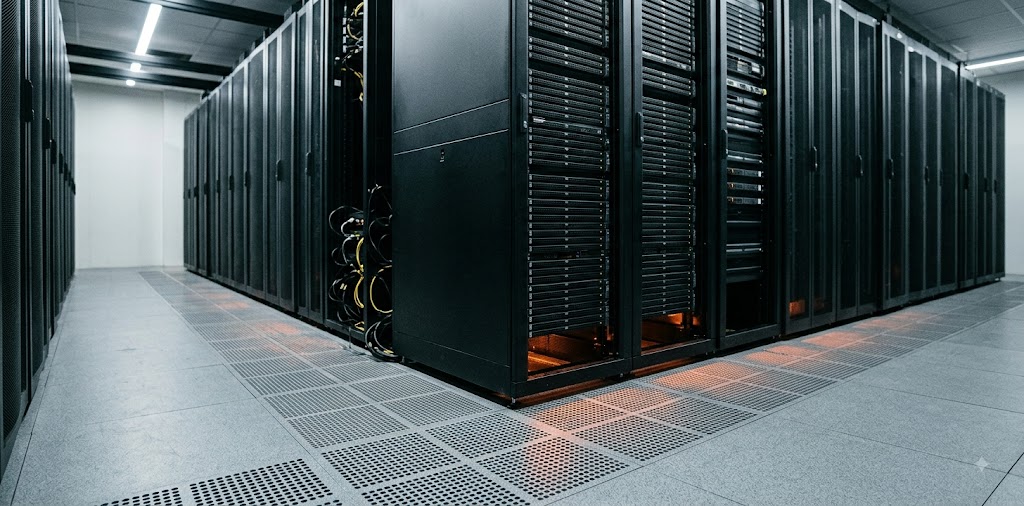
Data center cooling has become more demanding as facilities accommodate denser racks, higher power loads, and heat intensive AI applications. Maintaining the correct room temperature is only one part of the challenge. Heat must be captured, transported, and rejected reliably across the entire cooling system.
Problems can develop in airflow paths, chilled water pipes, coolant distribution units, heat exchangers, cooling towers, pumps, valves, and control systems. Effective thermal management therefore requires coordination between IT equipment, mechanical infrastructure, water treatment, monitoring, and maintenance teams.
How Data Center Cooling Systems Remove Heat
A data center cooling system moves heat through several stages. Servers generate heat, which is captured by air, cold plates, rear door heat exchangers, or immersion fluid. That heat is then transferred into a facility cooling loop and released through chillers, cooling towers, dry coolers, or economizers.
Every stage depends on the next. A cold plate cannot remove the required heat if coolant flow is inadequate. A chilled water loop cannot perform efficiently if deposits restrict distribution or heat exchanger surfaces are fouled.
Understanding the complete heat removal path helps operators avoid treating symptoms in isolation. Rising rack temperatures might result from poor airflow, an incorrect valve position, a blocked strainer, an unbalanced branch, insufficient pumping capacity, or contamination within the cooling network.
Rising AI And High-Density Heat Loads
AI accelerators and high-performance computing systems concentrate substantial power within relatively small areas. A few GPU racks can produce far more heat than conventional server racks, placing new demands on heat capture and distribution systems.
These loads may also change rapidly as training and inference activity increases or decreases. Cooling controls must respond without creating unstable temperatures, excessive pumping, or unnecessary energy consumption.
Traditional room level air cooling may struggle when rack density rises beyond its practical capacity. Direct-to-chip cooling, rear door heat exchangers, and other liquid cooling technologies move heat closer to its source, but they introduce new requirements for piping, coolant quality, pressure control, and leak detection.
Uneven Cooling And Localized Hot Spots
A data hall can maintain an acceptable average temperature while individual racks receive inadequate cooling. Hot spots occur when heated exhaust air recirculates into server inlets or when cool air bypasses the equipment it is intended to protect.
Containment, rack arrangement, fan control, and equipment placement all influence airflow. Changes to server density can also disrupt a cooling layout that previously performed well.
Liquid-cooled systems face a similar distribution problem. Incorrect balancing, insufficient branch flow, unstable differential pressure, or restricted piping can leave some racks or cold plates with inadequate coolant. Measuring conditions at the affected equipment is more useful than relying only on central plant readings.
Scaling Legacy Cooling Infrastructure
Many existing data centers were designed for predictable CPU workloads and lower rack densities. Adding AI equipment may exceed the capacity of the chillers, air handlers, pumps, piping, electrical systems, or heat rejection equipment.
Retrofitting liquid cooling requires more than installing cold plates or coolant distribution units. Operators must determine where new pipes will run, how they will be isolated, which materials and fittings are compatible, and how leaks will be contained.
Existing chilled water systems must also be assessed for additional flow and heat rejection demand. A phased approach may be necessary so new cooling capacity can be introduced without reducing the redundancy required for current operations.
Balancing Air And Liquid Cooling
Most facilities moving toward liquid cooling will continue to operate air and liquid systems together. Direct-to-chip systems remove heat from the highest load components, but memory, storage devices, power supplies, networking equipment, and other components may still rely on air.
Hybrid cooling requires careful capacity allocation. Operators need to understand how much heat the liquid system removes, how much remains in the room, and whether the existing air system can manage that residual load.
Facility chilled water and technology cooling systems should also be treated as distinct networks. The technology cooling loop serving cold plates may have tighter requirements for temperature, pressure, fluid quality, material compatibility, and particle control than the wider facility water system.
High Energy Use And Operating Costs
Cooling energy is affected by chiller performance, fan speed, pump operation, supply temperatures, outdoor conditions, equipment loading, and heat transfer efficiency. Overcooling the data hall or maintaining unnecessarily narrow humidity limits can add cost without improving reliability.
Restricted pipes and fouled heat exchangers create another source of energy waste. Pumps may work harder to maintain flow, while chillers and air handlers operate longer because heat is not being transferred efficiently.
Power Usage Effectiveness helps track the relationship between total facility energy and IT equipment energy. However, a low PUE does not confirm that every rack receives adequate cooling. Performance metrics should be evaluated alongside temperatures, flow rates, differential pressure, equipment load, and cooling capacity.
Water Consumption And Sustainability Pressures
Facilities using evaporative cooling towers consume water through evaporation, drift, and blowdown. Water demand can become a significant constraint in dry climates or regions facing increased pressure on municipal supplies.
Water Usage Effectiveness measures site water consumption relative to IT equipment energy. It can help operators compare cooling strategies, but energy and water performance should be considered together.
A system that reduces electrical consumption may increase direct water use. Dry coolers and warm water loops can reduce dependence on evaporation in suitable climates, although their performance still depends on outdoor conditions, system temperatures, and the cooling requirements of the IT equipment.
Water Quality And Coolant Compatibility
Water quality directly affects heat transfer, equipment condition, and system reliability. Important factors include pH, conductivity, dissolved oxygen, inhibitor concentration, glycol condition, microbial activity, and suspended solids.
Cooling networks may contain carbon steel, stainless steel, copper, aluminum, brass, polymers, seals, and elastomers. An unsuitable coolant or poorly controlled chemistry can accelerate corrosion and damage components.
Water treatment must match the particular loop. Open condenser water systems face different contamination risks from closed chilled water systems, while technology cooling systems may require much tighter fluid cleanliness and compatibility controls.
Scale, Biofilm, Sediment And Corrosion
Deposits can develop even when a cooling system continues to circulate. Scale may form on heat transfer surfaces, while corrosion products, sediment, and construction residue can accumulate in low flow branches or collect in strainers.
Biofilm can develop in stagnant areas, dead legs, or sections with inconsistent microbial control. These deposits may reduce heat transfer, restrict flow, contribute to corrosion, and release material into downstream equipment.
Warning signs include:
- Repeated filter or strainer blockage
- Declining flow through a known section
- Unexplained differential pressure changes
- Discolored or turbid cooling fluid
- Sediment found during sampling
- Poor circulation through cooling equipment
- Recurring water chemistry problems
- A gradual increase in pumping demand
Cleaning can remove accumulated material, but it does not correct the conditions that caused it. Water chemistry, oxygen ingress, incompatible materials, hydraulic design, and microbial control must be investigated separately.
Leak Detection And Liquid Containment
Liquid cooling brings water or another coolant closer to high value computing equipment. Reliable fittings, compatible materials, controlled operating pressure, and effective leak detection are therefore essential.
Cooling networks should be divided into sections that can be isolated quickly. Sensors placed around CDUs, manifolds, pipe joints, and rack connections can provide early warning before a small leak becomes a serious event.
Containment and emergency procedures must be planned during design rather than added after installation. The response plan should identify how the affected loop will be isolated while sufficient cooling remains available elsewhere.
Reliability, Redundancy And Maintenance Access
Cooling maintenance must be completed without compromising mission critical operations. Systems may use redundant pumps, chillers, heat exchangers, CDUs, and distribution paths so individual components can be isolated safely.
Redundancy on a diagram does not always equal usable capacity. The operations team must confirm that the remaining equipment can support the actual thermal load during maintenance, including temporary peaks and changing workload conditions.
A detailed maintenance procedure should address valve sequencing, system monitoring, communications, deposit capture, fluid recovery, emergency restoration, and the controlled return of the cleaned section to service.
How To Diagnose A Cooling Performance Problem
Cleaning or replacing equipment before identifying the cause can waste time and create additional operational risk. The investigation should begin with the affected racks, branches, and cooling equipment.
A practical assessment may include:
- Review rack inlet, outlet, and coolant temperatures
- Compare actual flow with design requirements
- Check pumps, valves, controls, and differential pressure
- Inspect strainers, filters, and heat exchangers
- Sample the cooling fluid and examine collected material
- Review pipeline drawings and recent system modifications
- Determine whether deposits are present and where they are accumulating
- Define measurable acceptance criteria before corrective work begins
Monitoring can reveal an abnormal temperature, pressure, or flow condition. It cannot physically remove deposits or confirm their composition. Inspection, sampling, and system history are needed to determine the appropriate response.
Why Cooling Pipeline Condition Matters
Chilled water pipes are responsible for transporting cooling capacity across the facility. Deposits that reduce the available bore or disturb hydraulic balance can contribute to low flow, rising differential pressure, repeated strainer blockage, and uneven cooling distribution.
Construction debris can also create problems before a new system enters service. Weld residue, mill scale, dirt, gasket fragments, and metal shavings may travel toward valves, heat exchangers, or other sensitive components when circulation begins.
Suitable data center cooling pipelines may require cleaning before commissioning, during planned maintenance, or after a confirmed contamination event. The method should be selected according to the pipe configuration, cooling fluid, deposit type, access, and required cleanliness level.
Where Ice Pigging Fits Into Cooling Maintenance
Ice pigging is a physical cleaning method that uses pumpable ice slurry to form a semi-solid plug inside a pipeline. Controlled pressure moves the slurry through the selected route, where it contacts the pipe wall and carries loosened material toward a receiving point.
Because the slurry conforms to many bends and diameter changes, it may be considered for cooling pipes where conventional rigid pigs are difficult to use. Understanding how ice pigging works also helps distinguish the process from normal circulation or high velocity water flushing.
The difference is important when attached deposits are suspected. Water flushing may transport loose material, while physical contact can provide a stronger cleaning action. A comparison of ice pigging and water flushing explains where each method may fit within a wider cleaning program.
Ice pigging does not correct insufficient cooling capacity, failed controls, active corrosion, poor water chemistry, or unsuitable system design. Cold plates, CDUs, coils, and compact heat exchangers also require separate compatibility checks and cleaning procedures.
The Ice Pigging™ team evaluates pipe dimensions, materials, bends, branches, valves, fluid composition, temperature, deposits, access points, isolation requirements, available pressure, discharge arrangements, and the permitted maintenance window.
Share your cooling system drawings, fluid details, known deposits, access points, and operational requirements to discuss a project-specific feasibility assessment.
Frequently Asked Questions
What Are The Main Data Center Cooling Challenges?
Common challenges include rising rack density, hot spots, inadequate cooling capacity, high energy use, water consumption, poor coolant quality, restricted flow, leaks, limited redundancy, and difficult maintenance requirements.
Why Do AI Data Centers Need More Cooling?
AI accelerators and GPUs concentrate substantial electrical power and heat within individual racks. These high thermal loads may exceed the practical capacity of conventional room level air cooling.
Is Liquid Cooling Better Than Air Cooling?
Liquid cooling can remove concentrated heat more efficiently and support higher rack densities. Air cooling remains necessary for many components and lower density workloads, so the correct strategy depends on the equipment and facility.
How Does Water Quality Affect Cooling Performance?
Poor water quality can contribute to scale, corrosion, biofilm, suspended solids, and coolant degradation. These conditions may reduce heat transfer, restrict flow, damage components, and increase maintenance requirements.
Can Ice Pigging Clean Data Center Cooling Pipes?
Ice pigging may clean suitable chilled water supply and return lines, headers, and distribution piping. Feasibility depends on pipeline geometry, fluid compatibility, access, deposits, pressure, isolation, and discharge arrangements.
Build Cooling Resilience Across The Complete System
Reliable data center cooling depends on more than adding capacity. Airflow, liquid distribution, pipeline condition, water chemistry, monitoring, redundancy, and maintenance must work together.
A system wide assessment helps identify whether a cooling problem originates at the rack, within the equipment, or in the wider distribution network. Correctly identifying that cause allows operators to select an appropriate response while protecting efficiency, equipment, and uptime.