
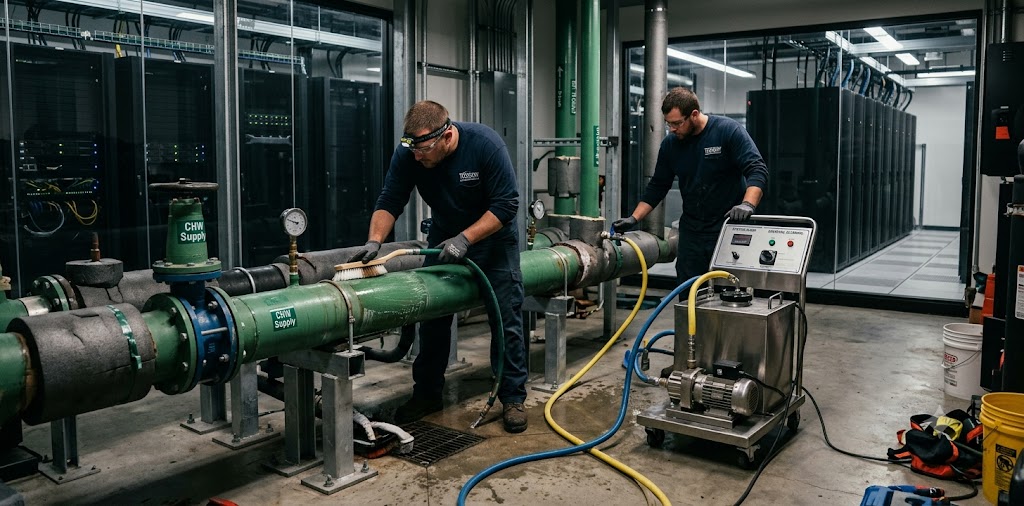
Chilled water pipe cleaning removes construction debris, sediment, corrosion products, biofilm, and other contaminants from data center cooling networks. Effective cleaning helps maintain reliable flow, protect sensitive equipment, and prepare new piping for commissioning.
The correct method depends on the type of cooling loop, pipe material, fluid composition, contamination, and operating requirements. Water flushing, filtration, chemical cleaning, and ice pigging each address different conditions, so the cleaning program must be designed around the system rather than a preferred method.
Why Chilled Water Pipe Cleaning Matters
Data centers depend on cooling systems that can operate continuously under demanding loads. Deposits inside chilled water piping may restrict flow, increase differential pressure, block strainers, and interfere with water distribution to cooling equipment.
Contamination may also reduce heat transfer, accelerate component wear, and contribute to corrosion beneath deposits. During commissioning, debris left inside new piping can delay system acceptance or reach control valves, cooling coils, pumps, and heat exchangers.
Pipe contamination is not the only possible cause of declining cooling performance. Pump operation, valve positions, system balancing, controls, air entrainment, and equipment condition should also be investigated before cleaning begins.
Understanding Data Center Cooling Loops
A data center may contain several water or coolant networks with different cleanliness requirements. Identifying the affected loop is essential because a cleaning method suitable for a large distribution header may not be appropriate for small passages inside cooling equipment.
Facility Chilled Water Loops
Facility chilled water systems commonly connect chillers, pumps, supply and return headers, CRAH units, and heat exchangers. These networks may include large pipe diameters, long distribution routes, branches, bypasses, and redundant equipment.
Suitable sections of these data center cooling pipelines may be isolated and cleaned independently. The available redundancy and the effect of isolation on cooling capacity must be assessed first.
Condenser Water Loops
Condenser water systems may be open or partially open to the environment. As a result, they can face greater exposure to sediment, mineral scale, biological growth, and airborne contaminants.
Cleaning must be coordinated with water treatment because removing deposits does not correct the conditions that caused them. Scale formation, corrosion, and microbial activity may return if the underlying chemistry remains uncontrolled.
Technology Cooling Systems
Technology cooling systems may include coolant distribution units, secondary loops, cold plates, direct to chip cooling circuits, and compact heat exchangers. These components often have narrower passages and stricter fluid requirements than facility chilled water piping.
Cleaning large connecting pipes does not mean that the same process should continue through CDUs, cold plates, coils, or internal heat exchanger passages. These components require separate compatibility checks and cleaning procedures.
What Accumulates Inside Chilled Water Pipes?
Contaminants vary according to the system’s age, materials, operating conditions, and water treatment history. Identifying the deposit helps determine whether physical cleaning, filtration, chemical treatment, or a combined program is appropriate.
Construction Debris And Residue
New piping may contain weld slag, mill scale, metal shavings, dirt, gasket fragments, oils, and other fabrication residue. Pressure testing and construction activity may introduce additional solids before commissioning.
If this material is not removed, it can collect in low points or move into strainers, valves, coils, and heat exchangers when circulation begins.
Corrosion Products And Sediment
Loose rust, magnetite, and other corrosion products can accumulate in low flow branches and oversized headers. Repeated system modifications may also release material that had previously remained attached to pipe walls.
Cleaning can remove loose corrosion debris, but it does not stop the underlying corrosion mechanism. Water chemistry, oxygen ingress, incompatible materials, and inhibitor levels must be evaluated separately.
Biofilm And Microbial Growth
Biofilm can develop where water remains stagnant, circulation is poor, or microbial control is inconsistent. It may collect on pipe surfaces and contribute to restricted flow, fouled strainers, and microbiologically influenced corrosion.
Physical cleaning can remove accumulated material from suitable piping. Ongoing microbial control is still necessary to reduce the likelihood of renewed growth.
Scale And Hardened Deposits
Mineral scale and strongly bonded deposits may not respond adequately to water flushing alone. Deposit specific chemical cleaning may be required to dissolve or soften the material.
Any cleaning chemistry must be compatible with pipe metals, seals, gaskets, valves, and connected equipment. Neutralization, rinsing, fluid disposal, and passivation may also be necessary.
Signs A Chilled Water Loop May Need Cleaning
Cooling performance data should be reviewed alongside fluid samples and physical evidence. Cleaning should address a confirmed condition rather than being selected solely because a system has reached a certain age.
Common warning signs include:
- Repeated strainer or filter blockage
- Declining flow through a known section
- Unexplained differential pressure changes
- Discolored or turbid cooling fluid
- Sediment found during sampling
- Debris released after construction work
- Insufficient flow through cooling equipment
- Evidence of biofilm or corrosion products
- Recurring water chemistry problems
These symptoms can have several causes. Inspection, sampling, flow measurements, maintenance records, and current piping drawings help determine whether deposits are present and where they are accumulating.
When Should Cooling Pipes Be Cleaned?
Data center chilled water pipe cleaning generally occurs during commissioning, planned maintenance, or corrective maintenance. Each situation requires a different approach to scheduling, isolation, and verification.
Before Commissioning
Pre-commissioning cleaning removes construction and fabrication debris before sensitive equipment enters normal operation. It may include sectional flushing, temporary filtration, chemical treatment, and physical pipeline cleaning.
Acceptance criteria should be established before work starts. Turbidity, particle count, strainer inspection, fluid chemistry, and visual discharge conditions may all contribute to the commissioning decision.
During Planned Preventive Maintenance
Planned cleaning should be based on system condition rather than an unsupported universal interval. Fluid analysis, filter loading, flow restrictions, pressure changes, and inspection findings can indicate when intervention is justified.
Condition based planning also helps the operations team coordinate cleaning with redundant cooling capacity and approved maintenance windows.
During Corrective Maintenance
Corrective cleaning may be required after contamination, biofouling, sediment release, recurring strainer blockage, or a significant decline in circulation. The immediate symptoms should be addressed while investigating the source of the problem.
A cleaning project may remove deposits from the pipeline, but corrosion control, water treatment, or equipment repairs may still be required afterward.
Chilled Water Pipe Cleaning Methods Compared
No single method addresses every contaminant or configuration. The most effective program may combine physical cleaning with filtration and water chemistry correction.
| Method | Best Suited To | Important Limitation |
|---|---|---|
| Water Flushing | Loose and mobile debris | May leave attached deposits |
| High Velocity Flushing | Construction particles and settled solids | Required velocity may be difficult in every branch |
| Filtration | Fine suspended particles | Does not directly clean pipe walls |
| Chemical Cleaning | Oils, scale, oxides, and some biological deposits | Requires strict material and chemistry controls |
| Ice Pigging | Deposits in suitable distribution piping | Requires isolation, access, compatibility, and discharge planning |
| Combined Cleaning | Mixed contamination | Requires a carefully defined sequence |
Water Flushing And Filtration
Water flushing transports loose debris toward a discharge point. High velocity flushing creates turbulent flow to mobilize settled solids, although the required velocity may be difficult to achieve throughout complex branches and oversized headers.
Filtration removes suspended particles and may allow suitable fluid to be recovered. However, filtering circulating water does not necessarily remove material attached to the pipe wall. The differences between ice pigging and water flushing become especially relevant when attached deposits are suspected.
Chemical Cleaning
Chemical cleaning can address oil, scale, oxides, and certain biological deposits. The chemistry must be selected according to the contaminant, pipe material, operating fluid, and connected components.
Careful controls are required for concentration, temperature, circulation time, neutralization, rinsing, and disposal. Chemical cleaning may also need to be followed by passivation or inhibitor correction.
Ice Pigging
Ice pigging introduces a pumpable ice slurry that forms a semi-solid cleaning plug inside the pipeline. Controlled pressure moves the slurry through the selected route, where it contacts the pipe wall and carries loosened deposits toward a receiving point.
Understanding how ice pigging works helps distinguish the process from conventional flushing. The slurry can pass through many bends and changes in diameter, but the complete route must still be evaluated before cleaning.
Protecting Data Center Uptime During Cleaning
Cleaning an operating data center is not automatically an online process. The selected pipeline section will normally require controlled isolation even if the wider cooling network remains operational.
A detailed method of procedure should address redundant capacity, temporary connections, valve sequencing, monitoring, communication, and emergency restoration. Work may be divided into several sections so that sufficient cooling remains available throughout the project.
The plan should also identify approved injection and receiving points. Removed deposits, cooling fluid, rinse water, and melted ice must be captured, recovered, treated, or disposed of appropriately.
How Pipe Cleanliness Is Verified
Acceptance criteria should be agreed upon before fieldwork begins. No single measurement proves that every chilled water system has reached the required level of cleanliness.
Verification may include:
- Visual inspection of discharged material
- Turbidity and particle count
- Filter or strainer loading
- Differential pressure and flow measurements
- Glycol or inhibitor concentration
- pH and conductivity
- Microbial testing where appropriate
- Examination of collected deposits
Results should be evaluated against commissioning requirements, water treatment specifications, equipment manufacturer guidance, and the operational needs of the facility.
How The Ice Pigging™ Team Assesses Cooling Lines
Ice pigging may be considered for chilled water supply and return lines, headers, and suitable primary or secondary distribution piping. Potential routes are reviewed individually to confirm that the method is compatible with the pipeline and cooling fluid.
The assessment considers pipe material, diameter changes, bends, valves, branches, operating temperature, fluid composition, expected deposits, available pressure, access points, discharge arrangements, and the permitted maintenance window.
This approach helps determine where the benefits of physical pipeline cleaning may support a broader maintenance program. Ice pigging can complement filtration, corrosion control, microbial management, and ongoing water treatment, but it does not replace those measures.
Share your system drawings, cooling fluid details, known deposits, access points, and maintenance requirements for a project specific feasibility assessment. Additional ice pigging questions cover compatibility, access, safety, scheduling, and pipeline suitability.
Frequently Asked Questions
Why Do Data Center Chilled Water Pipes Need Cleaning?
Cleaning removes debris and deposits that may restrict flow, block strainers, increase differential pressure, or reach sensitive cooling equipment. It is especially important before commissioning and after confirmed contamination events.
What Is The Best Cleaning Method?
The best method depends on the deposit and system configuration. Loose solids may respond to flushing and filtration, while scale may require chemical treatment and attached deposits in suitable pipes may benefit from ice pigging.
Can Chilled Water Pipes Be Cleaned While The Data Center Operates?
The wider facility may remain operational when sufficient redundancy is available. However, the selected cleaning route normally requires controlled isolation and a documented restoration procedure.
Can Ice Pigging Clean Water And Glycol Loops?
Some water and glycol systems may be suitable after compatibility checks. Fluid composition, temperature, materials, slurry behavior, recovery requirements, and return to service procedures must be reviewed first.
How Often Should Cooling Pipes Be Cleaned?
There is no appropriate universal schedule for every data center. Cleaning should be guided by commissioning requirements, inspection findings, water analysis, filter loading, pressure changes, and verified performance problems.
Plan Cleaning Around The Cooling System
A reliable cleaning program begins with the cooling system, contamination, and required cleanliness level. Pipe configuration, fluid compatibility, operational redundancy, deposit capture, verification, and coordinated return to service must all be considered.
A project specific assessment can identify suitable cleaning routes and determine how physical cleaning should work alongside filtration, chemical treatment, and ongoing water chemistry management.