
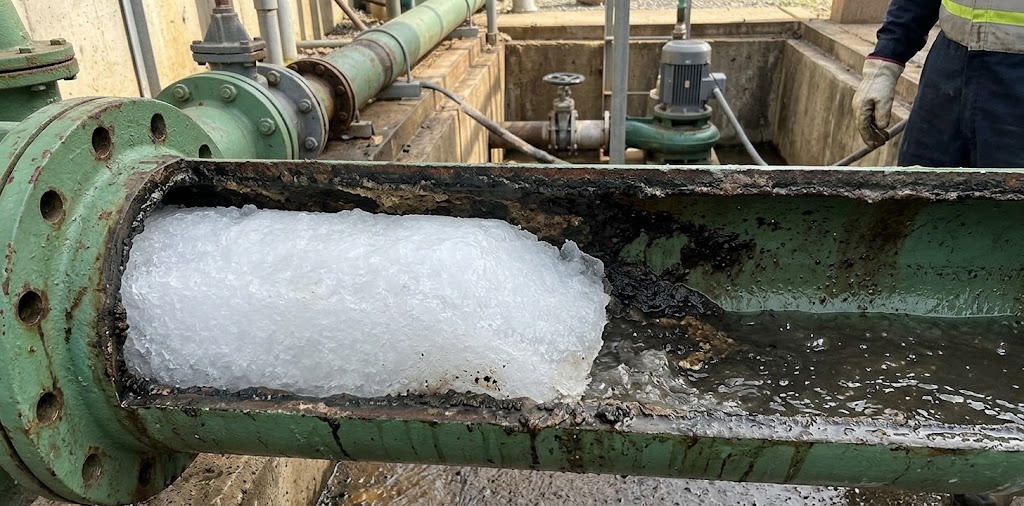
Ice pigging cleans a pipeline by moving a pumpable mixture of small ice crystals and liquid through a selected section. Inside the pipe, the mixture behaves like a soft cleaning plug that contacts the internal surface, loosens compatible deposits, and carries removed material toward a planned discharge point.
The active cleaning pass is only one part of the work. A complete project also includes pipeline review, route isolation, slurry preparation, controlled injection, pressure and flow monitoring, discharge management, final flushing, verification, and system restoration.
What Is An Ice Pig?
An ice pig is not a solid block shaped to match the pipeline. It is a dense slurry containing ice crystals suspended in a carrier liquid, which allows the mixture to be pumped through hoses and suitable access fittings.
Once enough slurry enters the pipeline, it forms a semi-solid plug. This combination gives it some of the displacement and surface contact of a conventional pig while allowing it to deform through many bends, valves, fittings, and diameter changes.
Many water applications use a compatible freezing point depressant to control slurry formation. The composition must suit the operating fluid, pipe materials, connected equipment, discharge requirements, and conditions for returning the system to service.
A fuller explanation of what ice pigging is helps distinguish the slurry from solid pigs, gel pigs, water flushing, and other pipeline cleaning methods.
Why Ice Slurry Cleans The Pipe Wall
Water flowing through a pipe generally moves faster near the center and more slowly near the internal surface. As a result, ordinary flushing may carry loose material while leaving strongly attached deposits behind.
A concentrated ice slurry fills more of the available pipe cross section. Movement within the deformable plug concentrates cleaning action near the pipe wall while the slurry displaces fluid and material along the route.
This process produces three connected effects:
- Physical contact with the internal pipe surface
- Detachment of compatible residue and deposits
- Transport of loosened material toward the receiving point
The ice does not grind through every possible obstruction. Deposit hardness, adhesion, volume, pipe condition, slurry properties, temperature, and available flow all affect the result.
Step 1: Define The Cleaning Objective
Every project should begin with a clear reason for cleaning. A utility may need to remove sediment associated with discoloration, while an industrial facility may be addressing reduced flow, biofilm, product residue, or recurring strainer blockage.
Other objectives may include removing construction debris before commissioning, supporting a product changeover, improving differential pressure, or preparing a pipe for inspection.
The objective determines which pipeline section should be cleaned and what evidence will demonstrate success. It also affects discharge planning, sampling, isolation, and the required work window.
Step 2: Review The Pipeline For Feasibility
The route must be assessed before equipment reaches the site. Ice pigging is not an automatic fit for every pipeline that contains buildup.
The review normally considers:
- Pipe material, diameter, length, and internal lining
- Bends, branches, valves, fittings, and restrictions
- Operating fluid and normal temperature
- Known or suspected deposits
- Available pressure and flow
- Isolation points
- Injection and receiving access
- Connected equipment
- Discharge capacity
- Verification and restoration requirements
Pipeline drawings provide an important starting point, but they should be compared with current field conditions. Unrecorded modifications, closed valves, damaged components, or inaccessible connections can change the proposed cleaning route.
Step 3: Isolate And Prepare The Route
The selected section is isolated or placed into a controlled configuration before slurry injection. Valve positions, bypass arrangements, customer or production effects, and sensitive downstream equipment must all be considered.
Technicians then prepare the work area, cleaning equipment, hoses, temporary connections, water supply, injection point, and receiving location. The discharge route is confirmed before cleaning begins so released material does not enter equipment that must remain protected.
Potable water, wastewater, food processing, cooling, and industrial systems require different hygiene and safety controls. Preparation should match the fluid, contaminants, operating environment, and applicable facility procedures.
Step 4: Prepare And Inject The Ice Slurry
The slurry is prepared or delivered at a consistency suitable for the pipeline and cleaning objective. Important factors include ice concentration, crystal properties, carrier fluid, temperature, required volume, and expected melting during the run.
There is no universal slurry recipe for every project. A long warm pipeline may require a different plan from a short cold water main because the ice changes as it absorbs heat.
The slurry enters through a suitable hydrant, valve, fitting, or temporary connection. Connections are secured, air is managed, and injection is controlled so the pipeline and connected equipment remain within their operating limits.
The commercial ice pigging process brings these preparation, injection, cleaning, and discharge stages into one planned field procedure.
Step 5: Move The Ice Through The Pipeline
Controlled water pressure or another compatible driving fluid moves the slurry along the selected route. The purpose is not to apply the highest possible pressure, but to maintain stable movement and sufficient cleaning action within the approved limits.
Operators monitor pressure, flow, and system response during the run. Unexpected readings may indicate an incorrect valve position, restriction, changing slurry condition, or another feature affecting movement.
Pipeline length, fluid temperature, pipe temperature, flow rate, and ambient conditions influence how quickly the ice melts. Larger or staged slurry volumes may be considered where thermal conditions could weaken the plug before it reaches the outlet.
If movement stops, the ice can be allowed to melt and then flushed from the line. This reduces the solid blockage risk associated with a rigid pig, although careful isolation, monitoring, and discharge planning are still required.
Step 6: Discharge The Ice And Removed Material
The receiving point is prepared to handle water, slurry, and the material removed from the pipeline. Depending on the project, discharge may be collected in a tanker, passed through filtration, sampled, treated, or routed to an approved disposal location.
The discharge may arrive in stages. Leading water is followed by displaced product or pipeline fluid, the ice slurry, removed deposits, trailing water, and the final flush.
Temperature and conductivity can help indicate slurry arrival in applications using saline ice. Temperature may fall and conductivity may rise as the ice approaches the outlet.
These readings track the cleaning medium. They do not independently prove how much biofilm, sediment, grease, scale, or product residue was removed.
Step 7: Flush And Verify The Pipeline
After the main slurry has discharged, the line is flushed until remaining ice, additive, and loosened material meet the project requirements. The appropriate endpoint depends on the application.
Verification may include:
- Discharge samples and photographs
- Turbidity, conductivity, and temperature
- Total suspended solids
- Particle count or filter loading
- Flow and differential pressure
- Water quality testing
- Microbial, product, or allergen testing
- Visual or borescope inspection
A defensible approach to measuring ice pigging results connects these observations with baseline data and acceptance criteria established before cleaning.
Dark or heavily contaminated discharge confirms that material left the pipeline. It does not prove that every internal surface is completely clean or that the system has met its return requirements.
What Can Ice Pigging Remove?
Ice pigging can physically remove several types of compatible buildup from suitable pipelines. Performance depends on the deposit, its hardness, thickness, adhesion, and interaction with the internal pipe surface.
Potential targets include sediment, biofilm, iron and manganese deposits, loose tuberculation, grease, fats, product residue, soft mineral deposits, construction debris, and loose corrosion products.
Heavily cemented scale, structural obstructions, collapsed pipework, and complete blockages may require jetting, chemical cleaning, mechanical intervention, excavation, or repair before an ice route becomes viable.
Where Is Ice Pigging Used?
The range of ice pigging applications includes municipal, utility, manufacturing, process, and energy systems. Each sector requires different planning and acceptance criteria.
Drinking Water Mains
Suitable water mains and wastewater pipelines may be cleaned to remove sediment, biofilm, discoloration-causing deposits, grease, and soft solids.
Potable systems must follow the utility’s flushing, disinfection, sampling, and return to service procedures. Ice pigging performs physical cleaning but does not automatically replace those requirements.
Food And Beverage Pipelines
Ice slurry may help recover residual product and remove fats, proteins, sugars, biofilm, and other material from suitable processing lines.
Physical cleaning can support CIP and sanitation, but it does not replace validated hygiene or allergen controls. Product compatibility, equipment protection, discharge recovery, and microbial acceptance must be reviewed.
Industrial And Cooling Systems
Industrial and cooling lines may accumulate sediment, corrosion products, biofilm, mineral material, and construction debris. Cleaning may support flow recovery, commissioning, heat transfer, or fluid quality objectives.
Pumps, compact heat exchangers, instruments, strainers, and treatment chemistry require separate assessment before the slurry route is approved.
How Ice Pigging Compares With Other Methods
Ice pigging occupies a specific place between water flushing and rigid mechanical cleaning. It provides more direct surface contact than ordinary water flow while remaining deformable.
Water flushing and ice pigging differ mainly in how they interact with deposits. Flushing relies on hydraulic movement, while ice slurry acts as a plug that contacts the pipe wall and carries removed material forward.
Conventional pigging can produce strong mechanical contact, but the pig must physically navigate the route. The comparison with conventional pipeline pigs is especially important where the pipeline contains diameter changes, valves, tight geometry, or limited launcher and receiver access.
What Ice Pigging Does Not Do
Ice pigging is a cleaning method, not a structural inspection or repair process. It does not measure wall thickness, identify every defect, restore a damaged lining, repair leaks, or correct poor hydraulic design.
It also does not automatically sanitize or disinfect a pipeline. Water treatment, corrosion control, validated CIP, microbial testing, and commissioning activities may remain necessary after physical cleaning.
The method may not be appropriate for completely blocked lines, collapsed pipes, heavily hardened deposits, excessively warm systems, or routes without practical isolation, injection, and discharge points.
How The Ice Pigging™ Team Plans Each Project
Every project begins with a technical review of the actual pipeline. The Ice Pigging™ team assesses pipe dimensions, materials, operating fluid, temperature, deposits, access, pressure, isolation, connected equipment, and discharge requirements.
The resulting plan covers slurry preparation, injection, controlled movement, monitoring, receiving arrangements, final flushing, verification, and restoration. This project-specific approach determines whether ice pigging can move safely through the proposed route and achieve the required result.
Share your pipeline drawings, dimensions, operating data, fluid details, access points, deposit information, and acceptance requirements to request a feasibility assessment.
Frequently Asked Questions
Ice pigging projects vary according to the system and cleaning objective. These answers address several common questions about the process.
What Pushes An Ice Pig Through A Pipeline?
Controlled water pressure or another compatible driving fluid moves the slurry through the isolated route. Flow and pressure are monitored throughout the cleaning run.
Can Ice Pigging Pass Through Bends And Valves?
The slurry can deform through many bends, full bore valves, fittings, and diameter changes. Every route must still be reviewed because some valves, restrictions, equipment, and branches may be unsuitable.
What Happens If The Ice Stops Moving?
The ice can be allowed to melt and then flushed from the pipeline. This reduces the risk of leaving a rigid cleaning device trapped inside the route.
Does Ice Pigging Require Excavation?
Many projects use existing hydrants, valves, fittings, or approved temporary connections. Excavation may still be needed if suitable access and discharge points are unavailable.
Does Ice Pigging Disinfect A Pipeline?
No. Ice pigging physically removes deposits. Required disinfection, sanitation, water treatment, and microbial testing remain separate processes.
How Long Does Ice Pigging Take?
Timing depends on pipe size, length, access, temperature, isolation, deposit load, slurry volume, discharge handling, flushing, and verification. Some projects fit within a short maintenance window, while complex networks require staged cleaning.
From Pipeline Review To Verified Cleaning
Ice pigging works by combining the pumpability of a liquid with the displacement and surface contact of a soft cleaning plug. The slurry loosens compatible deposits and carries them toward a controlled receiving point.
Reliable results depend on the complete process. Feasibility, slurry preparation, route control, monitoring, discharge handling, verification, and system restoration all determine whether ice pigging is the right method for a pipeline.