
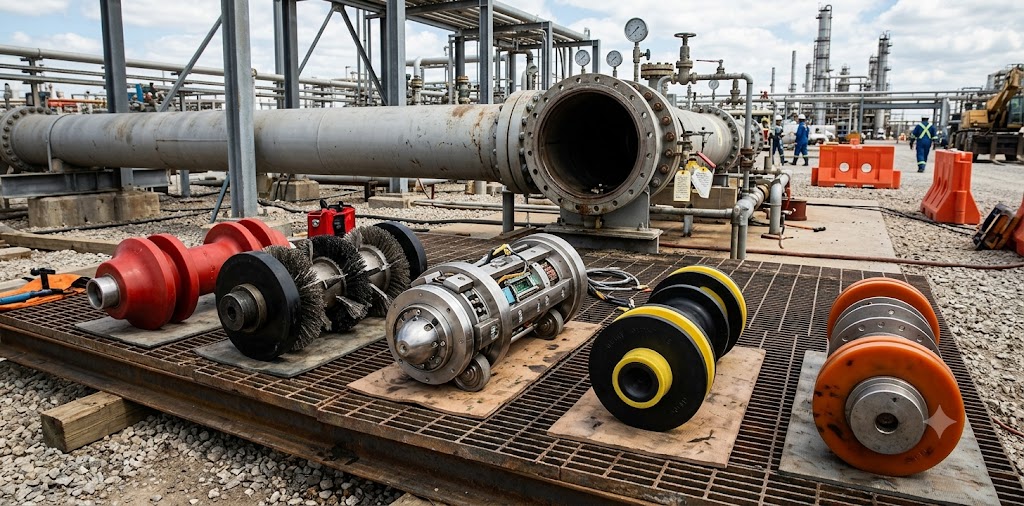
Pipeline pigging involves moving a device or pumpable medium through a pipeline to complete a specific maintenance, cleaning, product handling, or inspection task. Common objectives include removing deposits, separating products, displacing liquids, checking for restrictions, and assessing pipeline condition.
The phrase “types of pipeline pigging” can refer to two different classifications. Cleaning, batching, gauging, and inspection describe the purpose of an operation. Foam, mandrel, solid cast, spherical, gel, and ice describe the physical pig or cleaning medium used.
Understanding this distinction makes it easier to compare pipeline pigging methods and select an approach based on the pipeline, deposits, access, and required outcome.
Pipeline Pigging Types At A Glance
A pig configuration may support more than one function. For example, a solid cast polyurethane pig may be used for cleaning, product separation, or liquid displacement depending on its design and the operating conditions.
| Pigging Type | Primary Purpose | Common Pig Or Tool |
|---|---|---|
| Cleaning | Remove deposits and debris | Foam, mandrel, solid cast, brush, or ice |
| Sealing And Displacement | Move liquids or clear a line | Cup, disc, sphere, or foam pig |
| Batching | Separate dissimilar products | Sphere, cup, solid cast, or gel |
| Gauging And Proving | Identify restrictions or confirm passage | Gauging plate or proving pig |
| Inline Inspection | Measure pipeline condition | MFL, ultrasonic, geometry, or mapping tool |
| Product Recovery | Recover residual product | Hygienic or solid cast pig |
| Isolation | Temporarily isolate a pipeline section | Specialist isolation plug |
Pig selection should begin with the project objective. The body design, sealing components, attachments, and operating procedure can then be chosen around the pipeline conditions.
How Pipeline Pigging Works
Conventional pigging normally starts by inserting a pig through a launcher or another engineered access point. Pressure from liquid or gas propels it through the line, while cups, discs, or the pig body maintain contact with the internal pipe surface.
The pig is monitored as it travels and removed through a receiver. Any displaced fluid, debris, or recovered product must be collected and managed safely at the receiving location.
A typical operation includes:
- Reviewing the pipeline route and operating conditions
- Identifying the cleaning, displacement, or inspection objective
- Selecting and configuring the appropriate pig
- Establishing launching, tracking, and receiving procedures
- Controlling pressure and pig velocity
- Receiving the pig and managing discharged material
- Evaluating results before deciding whether another run is required
Not every pipeline has permanent launchers and receivers. Difficult geometry, limited isolation, and missing access infrastructure may require an alternative cleaning method or temporary modifications.
Types Of Pigging By Operational Purpose
These categories describe why the pigging operation is being performed. The selected pig may vary considerably within each category.
Cleaning Pigging
Cleaning pigging removes deposits, construction debris, and residual liquids from the internal pipe surface. Different pipeline cleaning pig types can scrape, brush, sweep, absorb, or transport contaminants to a receiving point.
Common cleaning targets include wax, paraffin, rust, black powder, sediment, mill scale, sand, biofilm, construction debris, and residual product. Deposit hardness and volume help determine how aggressive the cleaning configuration needs to be.
Progressive cleaning may be necessary when deposit loading is uncertain. Beginning with an aggressive pig can create a large debris plug or increase the risk of the pig becoming stalled.
Sealing And Liquid Displacement Pigging
Sealing pigs create a barrier between the driving medium and the fluid being displaced. Cups, discs, foam pigs, and spheres may be used to move water, hydrocarbons, condensate, or other liquids through a pipeline.
These operations support pipeline filling, dewatering, drying, hydrostatic testing, product recovery, and changes in pipeline service. Seal quality must be balanced against friction, wear, and the pressure available to move the pig.
Batching And Product Separation
Batching pigs separate two products or fluids moving through the same pipeline. They can reduce mixing between product batches and help operators recover more usable material.
Batching should not automatically be treated as cleaning. Although the moving pig may sweep some material from the pipe wall, its main objective is maintaining separation between fluids.
Gauging And Pipeline Proving
A gauging pig typically includes a metal plate sized to a defined percentage of the internal pipe diameter. Damage to the plate may indicate a bore restriction, dent, deformation, reduced bore valve, or other obstruction.
Gauging confirms whether a route can accommodate a particular tool, but it does not provide the detailed condition data produced by an intelligent pig. Gauging runs are often completed before inline inspection or commissioning.
Inline Inspection Or Smart Pigging
Smart pigs carry instruments that collect information about pipeline condition. Depending on the technology, they may detect corrosion, metal loss, cracking, dents, ovality, changes in geometry, or pipeline movement.
Magnetic flux leakage tools identify changes in magnetic fields associated with metal loss. Ultrasonic tools can measure wall thickness or inspect for cracks when appropriate coupling conditions are available.
Geometry and caliper tools measure restrictions, dents, wrinkles, and changes in bore. Mapping tools use inertial systems to record pipeline position, curvature, and movement.
A smart pig is not primarily a cleaning pig. Pipelines commonly require physical pipeline cleaning before inline inspection so debris does not interfere with the tool or collected data.
Product Recovery Pigging
Product recovery pigging is used in food, beverage, chemical, cosmetic, and other process industries. A hygienic pig pushes residual product toward a recovery point before water or cleaning chemicals are introduced.
Recovering material can reduce product waste, cleaning time, water consumption, and wastewater volume. The pig and seals must be compatible with the product, sanitation requirements, and pipeline design.
Types Of Pipeline Pigs By Construction
The physical construction of a pig affects its flexibility, sealing ability, cleaning force, durability, and ability to navigate the pipeline.
Foam Pigs
Foam pigs are available in different densities and may include coatings, brushes, or abrasive surfaces. Their flexibility can help them pass through uncertain geometry, moderate diameter changes, and certain restrictions.
They are commonly used for light cleaning, drying, liquid removal, and route proving. Foam pigs are generally less aggressive than rigid mechanical pigs and may not remove strongly attached deposits.
Mandrel Pigs
A mandrel pig has a central body fitted with replaceable cups, discs, brushes, magnets, blades, or gauging plates. Its modular construction allows the pig to be configured for cleaning, sealing, displacement, or proving.
Mandrel pigs are durable and reusable, but they require a confirmed piggable route. Valve bores, bend radii, tees, internal restrictions, and diameter changes must be evaluated carefully.
Solid Cast Polyurethane Pigs
Solid cast pigs are manufactured as one piece from polyurethane. They provide good sealing and abrasion resistance and are commonly used for cleaning, batching, displacement, and product recovery.
Different shapes and hardness levels are available. The correct configuration depends on the pipeline contents, internal diameter, deposit characteristics, and required sealing performance.
Spherical Pigs
Spherical pigs may be solid, hollow, or inflatable. They are commonly used for product separation, liquid removal, meter proving, and frequent automated pigging operations.
Their shape allows them to navigate certain bends and operate in systems designed for regular sphere launching. Their cleaning ability is limited when compared with pigs fitted with brushes or scrapers.
Brush, Scraper And Magnetic Configurations
Brushes, scrapers, and magnets are normally attachments rather than separate top-level pig categories. They change how a mandrel or other mechanical pig interacts with deposits.
Wire brushes can disturb corrosion products and harder material. Scrapers may target wax or scale, while magnets collect ferrous debris. Selecting attachments that are too aggressive can damage internal coatings or create excessive debris loading.
Gel Pigs
Gel pigs are viscous liquid systems rather than solid mechanical devices. They may be used for product separation, debris transport, chemical placement, dewatering, or as part of a larger pig train.
Their performance can be affected by dilution, temperature, pipeline contents, and operating conditions. Gel composition and compatibility must therefore be considered during planning.
Ice Pigs
Ice pigging uses a pumpable ice slurry that forms a semi-solid plug inside the pipeline. The slurry contacts the internal surface and carries loosened deposits toward a controlled discharge point.
Unlike a rigid mechanical pig, the ice plug can conform to many bends and diameter changes. If movement stops, it eventually melts, which can reduce some of the blockage concerns associated with solid devices.
The guide to how ice pigging works explains how the slurry is introduced, propelled, recovered, and assessed after cleaning.
Comparing Common Pipeline Pigging Methods
Each method has advantages and limitations. Pipeline geometry, deposit condition, inspection requirements, and operational risk should guide the comparison.
| Method | Main Strength | Important Limitation |
|---|---|---|
| Foam Pigging | Flexible and useful for light cleaning or drying | Limited against harder deposits |
| Mechanical Pigging | Configurable for aggressive cleaning | Requires a confirmed piggable route |
| Smart Pigging | Collects pipeline integrity data | Often requires cleaning and suitable geometry |
| Gel Pigging | Pumpable and useful for separation or debris transport | Performance can be affected by dilution |
| Ice Pigging | Conforms to complex pipework and melts if stalled | Does not perform instrumented inspection |
| Water Flushing | Uses relatively simple access arrangements | May leave attached deposits behind |
The comparison between conventional and ice pigging is especially relevant for pipelines with bends, diameter changes, limited access, or concerns about retrieving a rigid device.
How To Select The Right Pigging Type
No pipeline pig is appropriate for every application. Selection begins with the desired result, followed by a technical assessment of the route and operating conditions.
Important factors include:
- Pipe diameter, material, length, and internal coating
- Bend radius, tees, valves, and diameter changes
- Product or fluid inside the pipeline
- Deposit type, hardness, and estimated volume
- Available driving pressure and acceptable pig velocity
- Launcher, receiver, isolation, and tracking arrangements
- Discharge capacity and waste handling requirements
- Consequences of a stalled or damaged pig
- Required cleanliness or inspection criteria
A staged program may begin with a foam pig, progress to a general cleaning pig, and then introduce brushes, magnets, or gauging plates. An inline inspection tool may follow once the route has been cleaned and proved. This sequence is only an example and must be adapted to each pipeline.
Where Ice Pigging Fits
Ice pigging is a physical cleaning method for suitable drinking water mains, wastewater force mains, industrial process lines, food and beverage pipelines, cooling networks, and commissioning projects.
It can be considered when rigid pig geometry or blockage risk presents a concern. The pipeline cleaning applications vary because every industry has different fluid, hygiene, access, and return to service requirements.
Ice pigging does not replace smart pigging or instrumented integrity inspection. It may also be unsuitable for heavily hardened deposits that require mechanical removal or chemical treatment.
The Ice Pigging™ team assesses pipe dimensions, bends, branches, valves, fluid temperature, deposits, pressure, isolation, access, discharge arrangements, and operational requirements. This feasibility review determines whether an ice pig can move safely through the proposed route and deliver the required cleaning result.
Share your pipeline drawings, deposit information, access details, and cleaning objectives to discuss a project-specific approach. Additional ice pigging questions address suitability, preparation, scheduling, and verification.
Frequently Asked Questions
What Are The Main Types Of Pipeline Pigging?
The main operational types include cleaning, displacement, batching, gauging, inline inspection, product recovery, and specialist isolation. Each operation may use several different pig designs.
What Is The Difference Between A Cleaning Pig And A Smart Pig?
A cleaning pig removes deposits or debris. A smart pig carries sensors that collect information about corrosion, metal loss, cracking, dents, geometry, or pipeline position.
What Type Of Pig Is Used To Clean A Pipeline?
Foam, mandrel, solid cast, brush, scraper, magnetic, gel, and ice pigs may all support cleaning. The correct choice depends on the deposit, pipe geometry, access, and operating conditions.
Can Pipeline Pigs Pass Through Bends?
Many pigs are designed to pass through bends, but suitability depends on bend radius, pig length, sealing arrangement, internal diameter, and nearby fittings. The complete route must be reviewed before launching a pig.
What Happens If A Pig Becomes Stuck?
A stalled pig can restrict flow and may require pressure adjustments, reverse movement, excavation, or mechanical retrieval. Route proving, pig tracking, controlled cleaning, and an established contingency plan help manage this risk.
Is Ice Pigging A Form Of Smart Pigging?
No. Ice pigging is a physical pipeline cleaning process. It can remove and transport deposits from suitable pipelines, but it does not collect the instrumented integrity data produced by a smart pig.
Match The Pigging Method To The Pipeline
Cleaning, batching, gauging, displacement, and inspection are different operations, even when a particular pig supports more than one purpose. The best option depends on the objective, pipeline contents, deposits, geometry, access, pressure, and required result.
A thorough assessment helps determine whether the project needs a foam pig, mechanical pig, smart tool, gel system, ice pig, or staged combination of methods. The pipeline should guide the selection, not a preference for one pigging technology.