
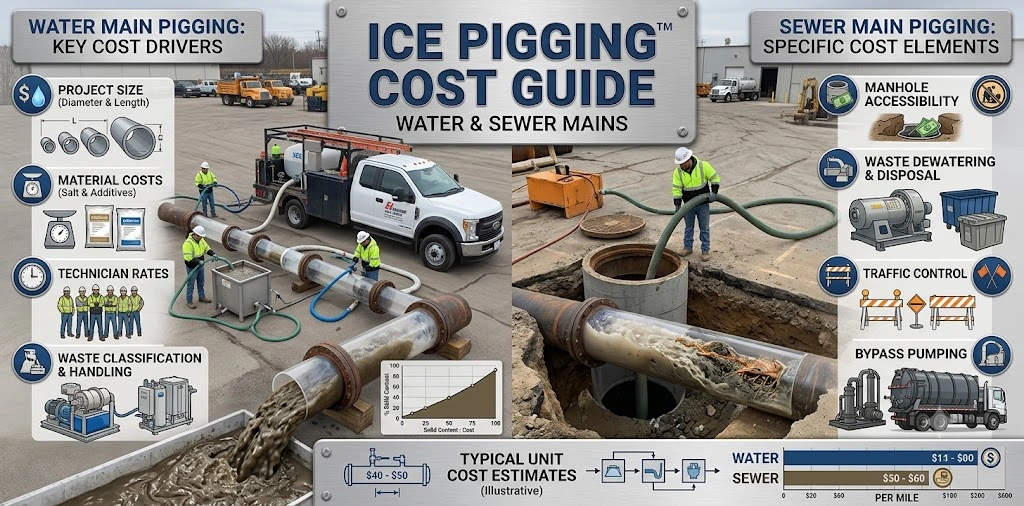
Every water and sewer main eventually needs cleaning, and cost is usually the first question a municipality asks before anything else. Budgets are tight, and nobody wants to approve a project without knowing what it will actually run.
This guide breaks down real ice pigging pricing, what drives the cost up or down, and how it stacks up against other cleaning methods. For background on the method itself, see what ice pigging is and how the process works.
How Much Does Ice Pigging Cost Per Foot?
Ice pigging typically runs between $1.70 and $5.50 per linear foot, depending on line diameter, condition, and project scope. Smaller, straightforward projects land toward the lower end of that range.
A real-world example makes this easier to picture. A municipality cleaned roughly 10,000 linear feet of problem water main using ice pigging, with total project cost landing around $30,000. That works out to a few dollars per foot, well within the expected range for a mid-sized project.
Larger diameter mains or sections with heavy sediment buildup can push costs higher, since more ice slurry is needed to maintain full contact with the pipe wall.
Ice Pigging Cost vs Other Cleaning Methods
Cost only means something in context, so here is how ice pigging compares to the other common cleaning methods on a dollar per linear foot basis.
Uni-directional flushing (UDF) tends to run around $0.98 per foot, making it the cheapest option upfront. Swabbing typically costs between $5.70 and $9.10 per foot. Traditional mechanical pigging runs highest, often between $16.10 and $21.00 per foot.
On paper, UDF looks like the budget winner. But flushing depends on volume, not contact, so it often requires repeat cleanings to reach the same result ice pigging delivers in a single pass. When you factor in sediment actually removed per dollar spent, ice pigging frequently comes out ahead of both flushing and swabbing.
What Drives the Cost of an Ice Pigging Project?
No two pipelines are the same, so no two ice pigging quotes look identical either. A handful of factors consistently move the price.
Pipe Diameter and Length
Larger diameter mains require more ice slurry to maintain contact across the full circumference of the pipe wall. Longer runs naturally require more material and more production time, which adds to the total.
Access Points and Site Conditions
Projects with existing hydrants, valves, or fittings in convenient locations cost less to set up. Limited access or complicated site logistics can add time and labor to a project.
Sediment Load and Obstructions
Heavier buildup means more material for the ice to carry out, which can extend the cleaning window. Ice slurry is also less effective at flagging obstructions early, so unexpected blockages can add cost if they are not identified during the site review.
What’s Included in an Ice Pigging Quote?
A quote is rarely just the ice itself. Most projects bundle mobilization, ice production, crew time, and discharge management into a single line item, so it helps to know what that actually covers.
- Mobilization and equipment setup at the access points
- Ice slurry production and injection through the line
- Crew labor for the duration of the cleaning pass
- Discharge management and disposal of removed material
- Documentation of results, including samples and observations
Traffic control permits and hydrant flow testing are sometimes handled separately, so it is worth confirming what is bundled into a given quote versus billed as an add-on.
Why Ice Pigging Often Costs Less Than It Looks
The per-foot number tells only part of the story. Several factors quietly bring the real cost down compared to other methods.
Ice pigging rarely requires excavation, since it works through existing access points in most cases. That alone removes a major cost driver that traditional pigging often carries.
Water usage is another factor. Ice pigging generally uses far less water than a comparable flushing program, which means lower water and disposal costs on top of the cleaning itself.
Because a single pass typically removes more sediment than flushing or swabbing, municipalities often avoid the cost of repeat cleanings scheduled just months later.
Water Mains vs Sewer Force Mains: Does Cost Differ?
Pricing structures are similar across drinking water mains and pumped sewer force mains, since both rely on the same ice slurry mechanics. The bigger differences usually come down to material type and discharge requirements rather than the cleaning method itself.
Sewer force mains sometimes carry additional costs tied to odor control or wastewater disposal regulations, depending on the local system. Water mains, by contrast, often carry stricter verification steps to confirm water quality before the line goes back into service.
When Ice Pigging Isn’t the Most Cost-Effective Option
Ice pigging is not the right fit for every pipeline, and knowing the limits ahead of time avoids wasted spend on a project that won’t deliver.
Gravity-fed sewers are not compatible with the process, since ice pigging depends on pumped flow to move the slurry through the line. Heavily encrusted scale or hardened tubercles also fall outside what a single ice pigging pass can remove, which usually calls for mechanical pigging instead.
Very large diameter mains can present similar challenges, since maintaining full contact across a wider pipe wall becomes harder to achieve efficiently.
How We Price Every Ice Pigging Project
Every quote starts with a site review, not a flat-rate estimate. Pipe diameter, material, length, access points, and pressure conditions all factor into a number before any slurry gets injected.
This approach keeps pricing tied to what a pipeline actually needs, rather than a generic per-foot rate applied across every project regardless of condition. Results are documented with samples and observations, so the cost maps directly to a measurable outcome.
FAQs
How much does ice pigging cost per linear foot?
Most projects fall between $1.70 and $5.50 per linear foot, though larger or more complex mains can run higher depending on diameter and condition.
Is ice pigging cheaper than swabbing or traditional pigging?
Yes, on a per-foot basis. Swabbing typically costs $5.70 to $9.10 per foot, and traditional pigging runs $16.10 to $21.00 per foot, both noticeably higher than ice pigging.
What factors affect the cost of an ice pigging project?
Pipe diameter, length, sediment load, and access point conditions are the biggest drivers. Larger or heavily fouled mains generally cost more to clean.
Does pipe diameter change the price of ice pigging?
Yes. Larger diameter pipes require more ice slurry to maintain full contact with the pipe wall, which increases production time and material cost.
What’s included in an ice pigging quote?
Most quotes include mobilization, ice production, crew labor, and discharge management. Traffic control or flow testing may be billed separately depending on the project.
Can ice pigging reduce long-term pipeline maintenance costs?
Often, yes. A thorough single pass can delay repeat cleanings and push back more expensive rehabilitation work, lowering the total cost of ownership over time.
Ready to Get a Real Number for Your Pipeline?
Every project has its own mix of diameter, length, and buildup, so the only accurate quote is one built around your actual system. Share your pipeline details and we’ll help you understand what a project would realistically cost. Request a feasibility review to get started, or visit our Ice Pigging to see the full range of services we offer.