
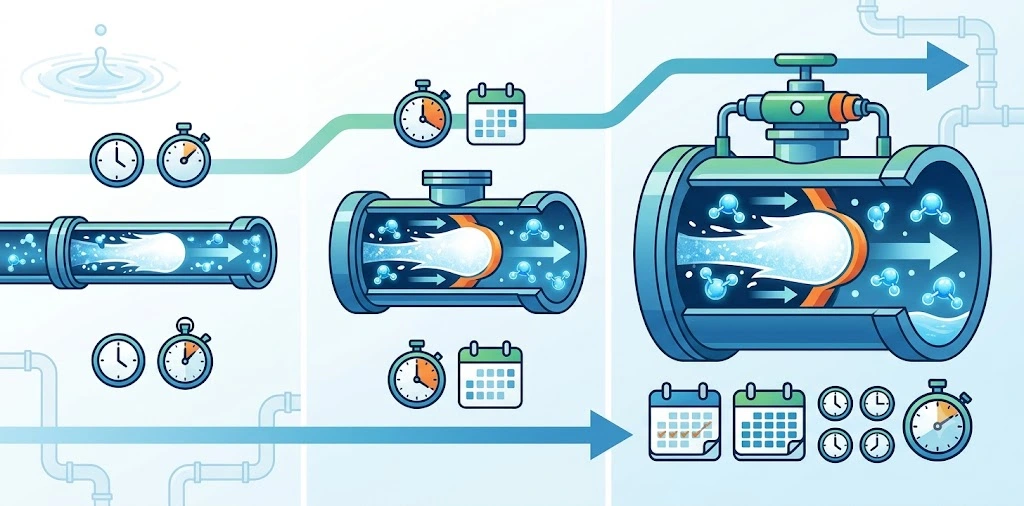
A prepared section of water main can often be cleaned using Ice Pigging™ within a few hours. Published project examples report isolation periods of approximately 30 to 180 minutes, while customer water interruptions commonly range from one to four hours.
However, the active movement of the ice slurry is only one part of the work. Pipeline isolation, equipment setup, flushing, water quality checks, and return to service procedures all contribute to the complete timeline.
Short, small diameter sections may be cleaned in minutes. Large diameter mains and complex distribution networks may require shorter cleaning runs completed across several workdays.
Ice Pigging Timelines At A Glance
Every water distribution system has different operating conditions. These figures should be treated as general planning references rather than guaranteed production rates.
| Project Element | General Planning Reference |
|---|---|
| Short active cleaning pass | Minutes to under one hour in favorable conditions |
| Prepared water main section | Often completed within a few hours |
| Published pipeline isolation range | Approximately 30 to 180 minutes |
| Customer water interruption | Frequently around one to four hours |
| Favorable six inch water main | Up to approximately 2.3 to 2.5 miles per workday |
| Large or complex network | Multiple sections and workdays may be required |
| Water main above 24 inches | Requires an individual feasibility assessment |
Actual timing depends on internal pipe diameter, pipeline length, ice availability, system pressure, water temperature, access points, deposit loading, flushing, and acceptance requirements.
Active Cleaning Time Is Not The Complete Project Timeline
Three separate time periods should be considered when estimating an ice pigging project. Distinguishing between them provides a more accurate picture of the expected work window and customer disruption.
Active Pigging Time
Active pigging time begins when the engineered ice slurry enters the pipeline and ends when the ice pig and removed material reach the discharge point.
The slurry is propelled through the isolated section using controlled system pressure. Depending on the length, diameter, temperature, and flow rate, this stage may take several minutes or continue for a few hours.
Water Service Interruption
The service interruption covers more than the movement of the ice pig. It may include isolation, equipment connections, injection, discharge, flushing, operational checks, sampling, and preparation for returning the main to service.
A short cleaning pass may therefore require a longer outage. Crews must confirm that remaining ice, sediment, and disturbed material have been removed before normal operation resumes.
Total Project Duration
The total project schedule includes planning, customer notifications, ice production, mobilization, traffic control, site setup, multiple cleaning runs, reporting, and demobilization.
A municipal project may continue across several days while limiting the water interruption for each individual section to only a few hours.
What Happens During An Ice Pigging Work Window?
Careful preparation helps reduce service disruption. Pipeline drawings, valve locations, injection access, and discharge arrangements should be confirmed before the planned isolation begins.
A typical work window may include:
- Confirming the pipeline route, pipe sizes, valves, and access points
- Establishing traffic and site controls
- Isolating the selected section
- Connecting the injection and discharge equipment
- Conditioning or flushing the main when required
- Injecting the engineered ice slurry
- Propelling the ice pig using controlled pressure
- Collecting discharged ice, water, sediment, and debris
- Flushing the cleaned section with potable water
- Completing operational checks or required sampling
- Restoring valves and returning the main to service
The cleaning pass is not always the longest stage. Locating an undocumented valve, achieving complete isolation, managing heavy sediment, or meeting water quality requirements can take longer than moving the ice through the pipeline.
How Pipe Diameter Affects Ice Pigging Time
Pipe diameter has a significant effect on the quantity of ice required. When length remains the same, doubling the internal diameter creates approximately four times the pipe volume.
For example, a 12 inch water main contains roughly four times as much volume per foot as a six inch main. It therefore needs substantially more slurry to complete a comparable cleaning run.
A larger diameter can increase:
- Ice production and delivery requirements
- Slurry injection time
- Water and sediment discharge
- Wastewater management needs
- The number of ice loads or separate runs
- Equipment and site access requirements
This does not mean that a 12 inch main will always take four times longer. Available pressure, ice concentration, pipeline configuration, temperature, and access also influence the schedule.
Timelines By Water Main Size
The following size ranges offer a practical framework for early planning. A reliable project schedule still requires system drawings and an assessment of actual field conditions.
Small Diameter Water Mains
Water mains between approximately two and six inches require less ice per foot than larger pipes. Short, fully prepared sections may be cleaned in minutes, while longer sections can often be completed within a few hours.
Published field examples indicate that approximately 2.3 to 2.5 miles of favorable six inch main may be cleaned during one workday. Achieving that rate requires sufficient ice, suitable access, reliable valves, manageable deposits, and a relatively uncomplicated route.
Branches, dead ends, service connections, and repeated isolation requirements can reduce daily progress even when the pipe diameter is small.
Medium Diameter Water Mains
Mains between approximately eight and 12 inches require considerably more ice than a six inch pipeline. An individual section may still be cleaned within a few hours, but the distance covered by each ice load will normally be lower.
Crews must balance the proposed run length against available slurry, system pressure, water temperature, melting rate, and the distance between suitable injection and discharge points.
Several prepared sections may be completed in one day when they are close together. Longer sections may need to be divided into separate controlled runs.
Large Diameter Water Mains
Water mains between approximately 14 and 24 inches contain significantly more internal volume per foot. These projects often require shorter cleaning sections, greater quantities of ice, or multiple ice loads.
Transmission mains may also serve large areas or critical facilities. Pressure management, discharge capacity, temporary connections, and maintaining supply elsewhere in the network can affect the working schedule.
The active cleaning pass may remain relatively brief, but preparation and return to service procedures can occupy a larger portion of the outage.
Water Mains Larger Than 24 Inches
Ice pigging is generally most practical for pipelines up to approximately 24 inches, although the workable limit depends on the available equipment and specific system conditions.
Larger mains require an individual engineering and feasibility review. Mechanical pigging, swabbing, water jetting, or a combined cleaning strategy may be more practical when ice volume or access requirements become excessive.
What Can Extend An Ice Pigging Schedule?
Accurate system information is essential for maintaining a predictable timeline. An incorrect pipe diameter, missing branch, or valve that does not provide complete isolation can alter the cleaning plan after the crew arrives.
Other factors that may extend the schedule include:
- Inoperable, buried, or inaccessible valves
- Limited injection or discharge access
- Heavy sediment, biofilm, iron, or manganese deposits
- Warm water that accelerates ice melting
- Unknown bends, fittings, and diameter changes
- Traffic restrictions and permit requirements
- Critical customers with limited outage tolerance
- Additional flushing or water quality sampling
- Limited discharge water and sediment handling options
A site assessment helps identify these conditions before the outage. It can also determine whether temporary connections, valve repairs, or other enabling work will be required.
Can Ice Pigging Be Completed Overnight?
Night work may be practical for short, thoroughly assessed sections with reliable isolation valves and prepared access points. Scheduling the cleaning during periods of lower demand may reduce disruption for homes, businesses, and industrial facilities.
A successful overnight operation still requires sufficient ice, approved discharge arrangements, lighting, traffic control, trained personnel, and clearly defined acceptance criteria.
Night scheduling changes the working window, but it does not eliminate the preparation needed for a controlled and efficient cleaning operation.
Is Ice Pigging Faster Than Water Flushing?
Traditional water flushing may be simpler to arrange because utilities already have hydrants, valves, and trained operators. However, flushing can require several pipe volumes before discharged water becomes acceptably clear.
Ice Pigging™ provides concentrated physical cleaning during a controlled pass. The semi-solid slurry contacts the internal pipe surface, removes deposits, and carries loosened material toward the discharge point.
Timing should be compared against the required cleaning result. A brief flush may not provide a meaningful time saving if attached sediment or biofilm remains and repeated maintenance is needed.
How Quickly Can A Water Main Return To Service?
After the ice pig exits, the section is flushed until remaining ice, debris, and disturbed material have been removed. Crews may then check turbidity, conductivity, chlorine residual, pressure, appearance, or other required field parameters.
Some systems also require bacteriological or laboratory testing. Local procedures and the utility’s acceptance criteria determine whether the main can return immediately or remain isolated until additional results are available.
Once accepted, operators restore the correct valve positions and monitor the network for pressure changes, discolored water, or other operational concerns.
How The Ice Pigging™ Team Plans A Predictable Work Window
A realistic schedule begins with a review of pipeline maps, materials, internal diameters, total footage, valves, branches, fittings, system pressure, water temperature, and expected deposits.
The Ice Pigging™ team also evaluates injection points, discharge options, ice requirements, customer interruption limits, wastewater handling, flushing procedures, and water quality criteria.
These findings support a section by section plan covering anticipated work windows, ice quantities, access requirements, discharge arrangements, and return to service procedures.
Share your pipeline drawings and operating requirements to discuss an appropriate cleaning approach and project specific timeline.
Frequently Asked Questions
How Long Does A Typical Ice Pigging Operation Take?
A prepared water main section can often be cleaned within a few hours. The exact duration depends on pipe diameter, length, ice volume, isolation, access, deposits, and return to service requirements.
How Long Will Customers Be Without Water?
Published project examples commonly report interruptions of approximately one to four hours. The actual outage may be longer when extensive flushing, sampling, or operational checks are required.
How Much Water Main Can Be Ice Pigged In One Day?
Favorable projects have cleaned approximately 2.3 to 2.5 miles of six inch water main in one workday. Larger diameters, heavy deposits, complex networks, and limited access reduce daily coverage.
Does Ice Pigging Require The Main To Be Shut Down?
The target section normally requires controlled isolation. Depending on the network configuration, the wider water distribution system may remain operational while that section is cleaned.
What Happens If The Ice Pig Stops Moving?
The ice slurry can be allowed to melt and then flushed from the pipeline. This characteristic reduces the blockage risk associated with rigid mechanical pigs.
Plan The Timeline Around The Pipeline
Most prepared water main sections can be ice pigged within hours, but the complete timeline depends on more than the speed of the slurry.
Accurate mapping, functional valves, suitable access, sufficient ice, planned discharge, and defined acceptance criteria help create a shorter and more predictable work window. A project specific assessment remains the most reliable way to determine the required schedule.