
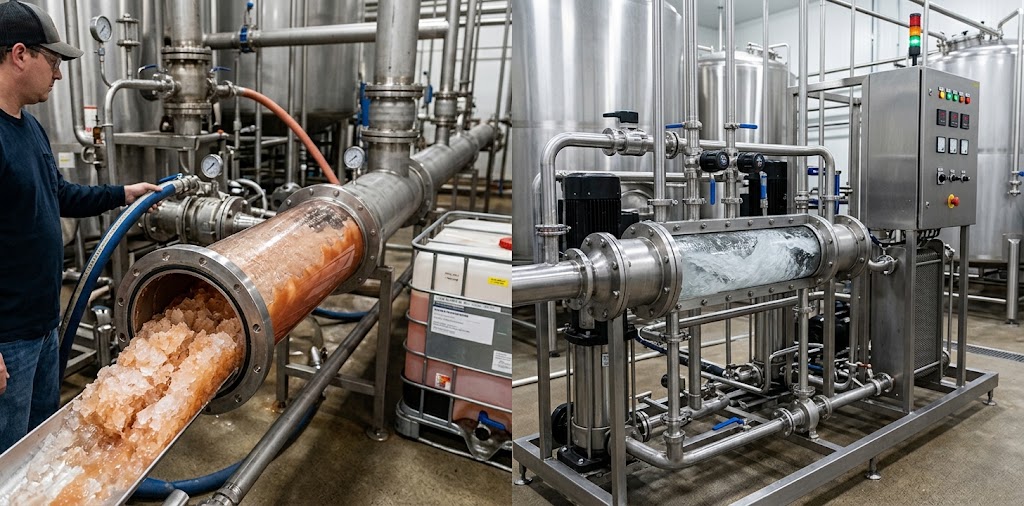
Ice pigging and clean in place are not opposing cleaning technologies. CIP circulates water, cleaning chemicals, and sanitizers through process equipment, while ice pigging moves a pumpable ice slurry through a selected pipeline to displace retained product and physically remove attached deposits.
A well designed CIP cycle may provide the required cleaning result on its own. Physical pipeline cleaning becomes relevant when product, biofilm, soft deposits, or other material remains after circulation, or when cleaning cycles are taking longer without delivering consistent results.
Ice Pigging And CIP At A Glance
The correct method depends on the product, deposit, pipeline design, hygiene requirements, and required result. In some facilities, ice pigging can reduce the soil entering the CIP cycle, while CIP continues to provide chemical cleaning and sanitation.
| Factor | CIP | Ice Pigging |
|---|---|---|
| Primary Action | Chemical action, heat, flow, and turbulence | Product displacement and direct slurry contact |
| Cleaning Medium | Water, detergent, acid, alkali, or sanitizer | Pumpable ice slurry |
| Main Purpose | Cleaning and sanitation | Physical residue and deposit removal |
| Typical Coverage | Compatible pipes, tanks, valves, and equipment | A selected compatible pipeline route |
| Product Recovery | Product is often diluted during the first rinse | Retained product may be recovered before dilution |
| Biofilm Role | Chemical and hydraulic removal | Physical detachment from accessible pipe surfaces |
| Main Limitation | Requires complete coverage and correct operating variables | Does not sanitize or suit every route or component |
Neither column guarantees cleanliness. Both processes require appropriate design, controlled operation, and evidence that the required outcome was achieved.
How CIP Cleans Process Equipment
CIP cleans internal surfaces without dismantling the complete system. A typical cycle may include a pre rinse, chemical wash, intermediate rinse, acid stage, sanitization, and final rinse.
Several variables work together during the cycle:
- Cleaning time
- Fluid temperature
- Chemical concentration
- Flow rate and turbulence
- Pressure
- Complete surface coverage
- Soil and product characteristics
- System drainage
CIP is not purely chemical. Turbulent flow and spray impact create mechanical cleaning action, while heat and chemistry help loosen or dissolve specific soils.
Problems arise when one or more variables fall outside the validated range. Inadequate flow, weak chemical concentration, cold cleaning solution, blocked spray devices, poorly positioned valves, or shortened contact time can all reduce cleaning performance.
Adding another cleaning method without diagnosing these conditions may only conceal the underlying CIP problem.
How Ice Pigging Cleans A Pipeline
Ice pigging uses a dense mixture of ice crystals and liquid that behaves like a deformable cleaning plug. Controlled pressure moves the slurry through the line, where it contacts the internal surface and carries loosened material to a receiving point.
The slurry can travel through many bends, fittings, valves, and diameter changes that may present difficulties for rigid pigs. If movement stops, the ice can melt and be flushed from the route, reducing the risk associated with leaving a solid cleaning tool inside the pipeline.
Ice pigging differs from conventional hygienic pigging. A product recovery pig primarily pushes valuable product from the line, while ice slurry also provides distributed physical contact that can help remove attached soft deposits and residue.
When A Correctly Designed CIP Cycle May Be Enough
Physical cleaning should not be added simply because a pipeline uses CIP. A properly designed and validated cycle may be sufficient when the product soil responds to the selected chemistry and every surface receives the required cleaning conditions.
CIP may be performing adequately when cycle data remain stable, rinse endpoints are predictable, and the line consistently passes its required ATP, allergen, protein, microbial, or product residue tests.
The system should also maintain expected flow, pressure, drainage, and production performance. If these indicators remain consistent, routine CIP may provide the required result without an additional physical cleaning stage.
Signs That Physical Pipeline Cleaning May Be Needed
Operators should look for a pattern of evidence rather than relying on one failed sample. Persistent cleaning problems may indicate retained deposits, but they can also result from equipment, chemistry, or process control faults.
CIP Cycles Keep Taking Longer
Longer pre rinses, increasing chemical demand, repeated cycle extensions, or slow final rinse recovery may indicate that the system is carrying a heavier soil load.
The cause might be changing product characteristics, incorrect CIP settings, poor flow, or deposits building along the pipe wall. These possibilities should be evaluated before selecting a corrective method.
Product Remains Inside The Line
Viscous foods, beverages, cosmetics, paints, and chemicals may drain slowly or coat internal surfaces. Sending this material directly into the first rinse increases wastewater strength and creates more work for the CIP system.
Using ice slurry before CIP may displace retained material toward a recovery or disposal point. Removing the bulk residue first can reduce the amount that must be diluted, heated, chemically treated, and flushed away.
Biofilm Or Attached Residue Returns
Recurring ATP results, microbial findings, odors, or visible material may indicate that the existing program is not removing an attached deposit. Increasing sanitizer concentration without confirming the cause may not resolve the problem.
Physical cleaning can help disrupt accessible biofilm and remove its supporting product residue. Required chemical cleaning, sanitation, and microbial verification must still follow the facility’s approved program.
Flow And Pressure Are Changing
Declining transfer rates, rising differential pressure, repeated strainer blockage, or unstable pump performance can indicate internal buildup.
These symptoms do not prove that the pipeline is dirty. Pumps, valves, instruments, controls, and downstream equipment should also be checked before cleaning is recommended.
How Ice Pigging And CIP Can Work Together
The sequence should be built around the product and validated cleaning requirements. In many process applications, physical removal occurs before chemical cleaning.
A combined sequence may involve:
- End production and isolate the selected route
- Drain or recover freely moving product
- Inject ice slurry to displace retained product and attached residue
- Capture and assess the discharged material
- Complete the required rinse or CIP cycle
- Apply the validated sanitation step
- Confirm final rinse and hygiene requirements
- Restore the line to production
This approach allows each method to perform a defined role. Ice pigging handles physical displacement and deposit removal, while CIP manages the required chemical cleaning and sanitation stages.
Some facilities may use ice pigging periodically rather than during every changeover. It can support planned remediation when normal cycles begin to lose effectiveness or when inspection confirms deposit accumulation.
For suitable food and beverage pipelines, the plan must account for product composition, hygienic design, allergens, pipe materials, valves, access, discharge, and production scheduling.
What Ice Pigging Does Not Replace
Ice pigging is not a substitute for every part of a facility’s cleaning program. It does not sterilize a pipeline or automatically satisfy microbial, allergen, or regulatory acceptance criteria.
Physical pipeline cleaning also does not replace:
- Validated CIP procedures
- Sanitization or sterilization
- Microbial and allergen testing
- Chemical compatibility reviews
- Tank and vessel spray coverage
- Membrane cleaning
- Equipment maintenance
- Hygienic system design
- Corrosion control
Tanks, heat exchangers, pumps, valve internals, instruments, membranes, and compact equipment require separate cleaning and compatibility assessments. A slurry route that works through process piping may not be appropriate through every connected component.
Ice pigging cannot correct dead legs, poor drainage, damaged seals, rough welds, failed valves, or completely blocked pipework. Those conditions require engineering changes, repair, or another cleaning method.
How To Select The Right Cleaning Approach
Start with the original problem and the required result. The choice should not be based on whether one method appears faster or uses fewer chemicals in a different facility.
Review the product and deposit composition, pipe material, internal finish, diameter, length, bends, valves, branches, and connected equipment. Available pressure, isolation points, injection access, receiving capacity, downtime, and waste handling also affect feasibility.
The wider range of industrial pipeline cleaning methods includes flushing, conventional pigging, ice pigging, jetting, chemical cleaning, air scouring, and ultrasonic methods. Hardened scale or complete restrictions may require a different solution from soft product residue or biofilm.
How Cleaning Results Should Be Verified
Completing a CIP cycle or discharging an ice pig does not independently prove that the line is ready for production. Acceptance criteria should be defined before cleaning begins.
CIP records may confirm time, temperature, pressure, flow, and conductivity. Additional verification may include final rinse pH, turbidity, ATP testing, protein or allergen testing, microbial sampling, total organic carbon, visual inspection, product residue analysis, or borescope inspection.
Ice pigging records may include injection and discharge data, flow, pressure, conductivity, turbidity, recovered material, water use, and cleaning duration. The process for measuring pipeline cleaning results should connect these readings with a reliable baseline and the facility’s acceptance requirements.
A dark discharge sample proves that material left the pipe. It does not confirm that every internal surface is clean or that hygiene requirements have been achieved.
How The Ice Pigging™ Team Assesses CIP Supported Cleaning
Every proposed route begins with a feasibility review. The Ice Pigging™ team evaluates pipeline drawings, pipe dimensions, bends, branches, valves, existing CIP data, product characteristics, known deposits, materials, pressure limits, and available access.
The assessment also considers isolation, slurry preparation, receiving arrangements, discharge handling, production downtime, verification, and return to service requirements. Ice pigging is recommended only when the route is compatible and physical cleaning supports a defined operational or hygiene objective.
The complete ice pigging process covers pipeline review, site preparation, controlled slurry injection, discharge management, final flushing, and verification. Share your line drawings, product information, CIP data, access points, and cleaning concerns to discuss a project specific assessment.
Frequently Asked Questions
Ice pigging and CIP can perform different roles within the same cleaning program. The following answers address common questions about integrating them.
Can Ice Pigging Replace CIP?
Not automatically. Ice pigging removes retained material through physical contact and displacement. CIP may still be required for chemical cleaning, sanitation, allergen control, and validated hygiene.
Is Ice Pigging A Form Of CIP?
Ice pigging cleans a pipeline without dismantling it, but it is different from a conventional CIP cycle. It uses a pumpable ice slurry rather than relying primarily on circulated cleaning fluids, heat, chemistry, and turbulence.
Does CIP Provide Physical Cleaning?
Yes. Fluid turbulence, spray impact, and hydraulic agitation provide mechanical action during CIP. Ice pigging adds contact from a deformable slurry moving through the pipe.
Can Ice Pigging Remove Biofilm?
Ice slurry can help detach biofilm from accessible surfaces in suitable pipelines. The facility may still require validated cleaning, sanitation, and microbial testing afterward.
Can Ice Pigging Reduce CIP Time?
It may reduce the amount of product and attached material entering the CIP cycle. Actual time, water, chemical, and energy savings must be measured under comparable operating conditions.
Can Ice Pigging Support Allergen Changeovers?
It may support physical residue removal between product runs, but it does not replace allergen validation. Suitability depends on the products, pipeline, materials, cleaning sequence, and required acceptance criteria.
Use Physical Cleaning For A Defined Reason
CIP remains essential where validated chemical cleaning and sanitation are required. Ice pigging adds value when evidence shows that retained product, biofilm, or attached deposits need stronger physical removal.
A successful program assigns each method a clear purpose, protects connected equipment, manages the discharge, and verifies the result before production resumes.