
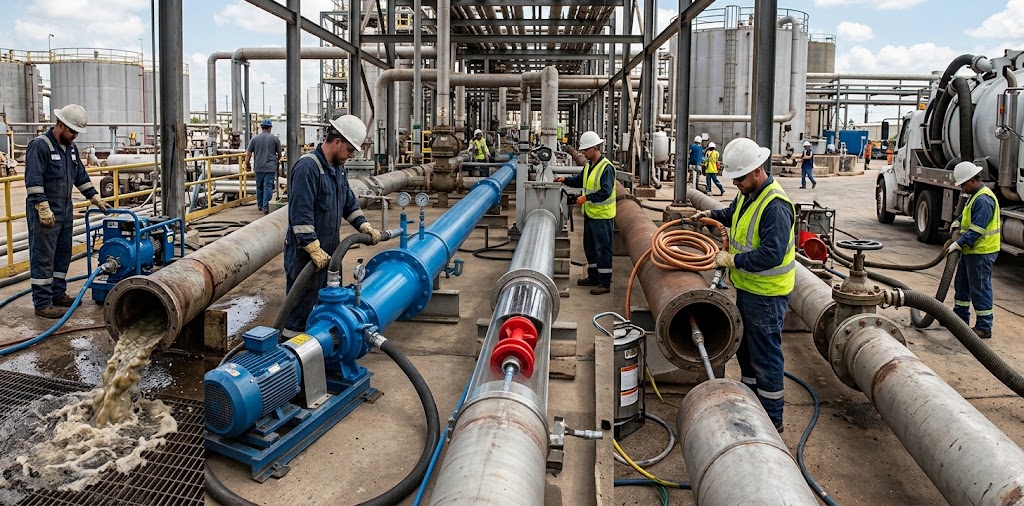
Industrial pipelines can accumulate sediment, corrosion debris, biofilm, mineral scale, grease, wax, product residue, and construction material. These deposits may reduce flow, increase pumping demand, contaminate products, block equipment, and contribute to unplanned downtime.
No single pipeline cleaning method is suitable for every system. The correct choice depends on the deposit, pipe material, internal condition, geometry, transported product, available access, operating limits, and required level of cleanliness.
What Accumulates Inside Industrial Pipelines?
The type of buildup depends on what the pipeline transports and how the system operates. Water pipelines may collect sediment, iron, manganese, biofilm, and mineral scale, while wastewater lines can accumulate fats, oils, grease, grit, and organic solids.
Industrial process lines may retain viscous product, chemicals, oils, wax, or cross contamination from a previous production run. Newly installed pipelines can also contain weld slag, mill scale, metal shavings, gasket fragments, hydrotest water, and fabrication residue.
Deposits should be identified before a cleaning method is selected. Loose sediment behaves differently from hardened scale, while a chemical treatment suitable for one pipe material may damage another material, lining, gasket, or seal.
Industrial Pipeline Cleaning Methods Compared
Each cleaning method produces a different type of action inside the pipeline. Some transport loose material, while others scrape, dissolve, soften, or physically carry deposits toward a receiving point.
| Method | Best Suited To | Main Limitation |
|---|---|---|
| Water Flushing | Loose sediment and debris | Limited contact with attached deposits |
| Mechanical Pigging | Wax, sludge, liquids, and loose scale | Requires a piggable route |
| Ice Pigging | Sediment, biofilm, grease, and residue | Not intended for complete blockages |
| Hydro Jetting | Hardened deposits in accessible sections | Limited by access, reach, and pipe condition |
| Chemical Cleaning | Scale, oils, oxides, and soluble deposits | Requires compatibility and waste controls |
| Air Blowing | Loose debris in dry systems | Limited effect on attached deposits |
| Steam Blowing | Debris and scale in suitable steam lines | Requires specialist equipment and controls |
A pipeline containing several types of contamination may require a staged program rather than one cleaning run.
1. Water Flushing
Water flushing uses controlled flow to mobilize loose material and carry it toward a discharge point. It is commonly used for construction debris, sediment, routine maintenance, rinsing, and preparation before another cleaning process.
Performance depends on water velocity, valve positions, pipe diameter, available pressure, drainage, and discharge capacity. Oversized headers, low flow branches, dead legs, and complex networks may not receive the same cleaning force.
Flushing creates less direct pipe-wall contact than physical cleaning methods. Loose material may be removed while attached biofilm, grease, or settled deposits remain. The differences between ice pigging and water flushing are important when repeated flushing is producing limited results.
2. Mechanical Pigging And Swabbing
Mechanical pigging uses foam, urethane, cup, disc, brush, or scraper pigs that travel through a pipeline under fluid or gas pressure. Depending on the tool, pigging can remove wax, sludge, standing liquid, loose scale, rust, and foreign debris.
Progressive cleaning normally begins with a softer or smaller pig. More aggressive tools can then be introduced after the route and debris load are better understood.
Mechanical pigging requires suitable launch and receiving access. The route must also be assessed for bends, tees, valves, restrictions, diameter changes, internal damage, and sufficient driving pressure. An unsuitable tool can damage coatings, release too much material at once, or become lodged inside the line.
3. Ice Pigging
Ice pigging uses a pumpable mixture of ice crystals and liquid. The slurry behaves like a fluid during injection but forms a semi-solid cleaning plug that contacts the internal pipe surface as it moves.
Because it is deformable, the slurry can navigate many bends, valves, fittings, and changes in diameter. It may remove sediment, biofilm, grease, corrosion debris, soft scale, and product residue from suitable pipelines.
The complete ice pigging process includes route assessment, site preparation, controlled slurry injection, discharge handling, flushing, and verification. If movement stops, the ice can melt instead of remaining as a permanently lodged rigid tool.
Ice pigging is not intended for complete blockages, severely restricted routes, heavily cemented scale, or advanced tuberculation. Connected equipment, fluids, pipe materials, access points, and pressure limits must be assessed before cleaning.
4. Hydro Jetting
Hydro jetting directs high-pressure water through specialized nozzles toward deposits. It can be effective against grease, sludge, roots, mineral scale, coke, and hardened residue in accessible pipeline sections.
Cleaning performance depends on water pressure, nozzle design, hose reach, pipe diameter, deposit strength, and the distance between the nozzle and the buildup. Long routes, complex bends, and limited access may reduce its effectiveness.
Excessive pressure can damage weak pipe walls, linings, seals, or connected equipment. Hydro jetting also creates high-pressure safety hazards and potentially large wastewater volumes, so trained operators, controlled work zones, and a discharge plan are essential.
5. Chemical Pipeline Cleaning
Chemical cleaning uses selected acids, alkaline solutions, solvents, surfactants, chelating agents, or deposit-specific formulations to dissolve, soften, or emulsify material.
Acid cleaning may address certain mineral scales and oxides. Alkaline solutions can target grease and organic residue, while compatible solvents may dissolve oil or product films.
The chemistry must match the deposit, pipe material, coating, seals, transported product, and downstream equipment. Concentration, temperature, circulation time, ventilation, neutralization, rinsing, passivation, and disposal all require careful control.
Chemical cleaning may loosen material without carrying every particle out of the pipeline. Flushing, filtration, or physical cleaning may still be needed to remove the released deposits.
6. Air Blowing
Air blowing uses compressed air to generate high-velocity flow through dry or pre-commissioning pipework. The moving air carries loose construction debris, dust, rust, and other mobile material toward a controlled outlet.
This method may be considered for suitable gas, process, utility, and instrumentation systems. Its effectiveness depends on air volume, pressure, pipeline configuration, and the condition of the debris.
Temporary connections, discharge silencers, debris capture, static control, exclusion zones, and safe venting must be included in the procedure. Air blowing has limited effectiveness against strongly attached, oily, or soluble deposits.
7. Steam Blowing
Steam blowing is a specialized pre-commissioning method for removing construction debris, mill scale, and loose oxides from suitable steam piping. High-velocity steam creates the cleaning force needed to carry material out of the system.
The procedure may include repeated blowing cycles and target-plate inspections to evaluate discharged debris. Temporary piping, thermal expansion, condensate drainage, noise, vibration, and discharge direction require detailed engineering.
Steam blowing uses substantial energy and exposes the system to high temperatures and forces. It should only be performed by experienced teams using an approved procedure and appropriate safety controls.
How To Choose The Correct Cleaning Method
Method selection should begin with the cleaning objective. Removing loose sediment, recovering product, preparing new pipework, restoring flow, and dissolving mineral scale require different equipment and acceptance criteria.
The assessment should consider:
- Deposit type, location, and hardness
- Pipe material, coating, diameter, and length
- Bends, branches, valves, and restrictions
- Operating fluid and normal temperature
- Available pressure and flow
- Injection and receiving access
- Connected equipment requiring protection
- Isolation and downtime limitations
- Fluid recovery and waste disposal
- Required cleanliness verification
The broad range of pipeline cleaning applications also demonstrates why the same method should not be applied automatically to drinking water, wastewater, cooling, hygienic process, petrochemical, and industrial production systems.
When Several Cleaning Methods Are Needed
Mixed deposits often require more than one cleaning action. Chemical treatment may soften scale before physical removal, while mechanical pigging may be followed by flushing and filtration to transport remaining particles.
The sequence matters. Releasing a large amount of debris without adequate receiving capacity can block strainers, valves, instruments, pumps, or downstream equipment.
A combined program should identify where material will travel, how it will be captured, and what evidence will confirm that each stage is complete.
How Pipeline Cleaning Results Are Verified
Completing a cleaning run does not automatically prove that the original objective was achieved. Acceptance criteria should be defined before work begins and connected to the operational problem.
Verification may include discharge samples, recovered-solids measurements, turbidity, particle count, filter loading, flow, differential pressure, CCTV inspection, water quality, product testing, microbial analysis, or target-plate examination.
A defensible approach to measuring cleaning results compares post-cleaning evidence with a reliable baseline. Pump speed, valve positions, demand, and downstream conditions should remain comparable when hydraulic improvement is evaluated.
How The Ice Pigging™ Team Assesses Pipelines
Every potential cleaning route is reviewed before ice pigging is recommended. The assessment considers pipe material, diameter, length, bends, branches, valves, transported fluid, expected deposits, access, pressure, isolation, discharge handling, and the required result.
Ice pigging may support suitable water, wastewater, district energy, food and beverage, cooling, commissioning, and industrial process pipelines. It can reduce dependence on repeated high-volume flushing while providing controlled collection of removed material.
The measurable benefits of physical cleaning depend on the system and project objective. Share your pipeline drawings, operating data, deposit information, access points, and acceptance requirements to discuss a project-specific feasibility assessment.
Frequently Asked Questions
What Is The Most Effective Pipeline Cleaning Method?
The most effective method is the one suited to the deposit, pipe configuration, material, operating limits, and required result. No single method is best for every industrial pipeline.
What Is The Difference Between Flushing And Pigging?
Flushing relies on fluid flow to transport loose debris. Pigging sends a cleaning medium through the line to provide stronger physical contact with the internal pipe surface.
Which Method Removes Hardened Scale?
Chemical cleaning or hydro jetting may be considered for hardened mineral scale. The selection depends on scale composition, pipe material, internal condition, access, and connected equipment.
Can Ice Pigging Clean A Completely Blocked Pipeline?
Ice pigging requires a viable route through the pipeline and is not intended for complete blockages. The restriction may need to be located and opened using another method first.
Can Several Cleaning Methods Be Combined?
Yes. Mixed deposits or complex systems may require chemical, mechanical, hydraulic, and filtration methods in a planned sequence.
How Often Should Industrial Pipelines Be Cleaned?
There is no universal interval. Cleaning frequency should reflect deposit formation, flow and pressure trends, fluid quality, product changes, inspection results, equipment condition, and operational risk.
Match The Method To The Pipeline
Effective industrial pipeline cleaning begins with identifying the material inside the line and understanding the pipeline that contains it. Geometry, access, pipe condition, operating limits, waste handling, and verification all influence the final decision.
A project-specific assessment helps select the least disruptive method capable of achieving the required result while protecting personnel, connected equipment, pipeline integrity, and normal operations.