
- The technology, explained
What is Ice Pigging?
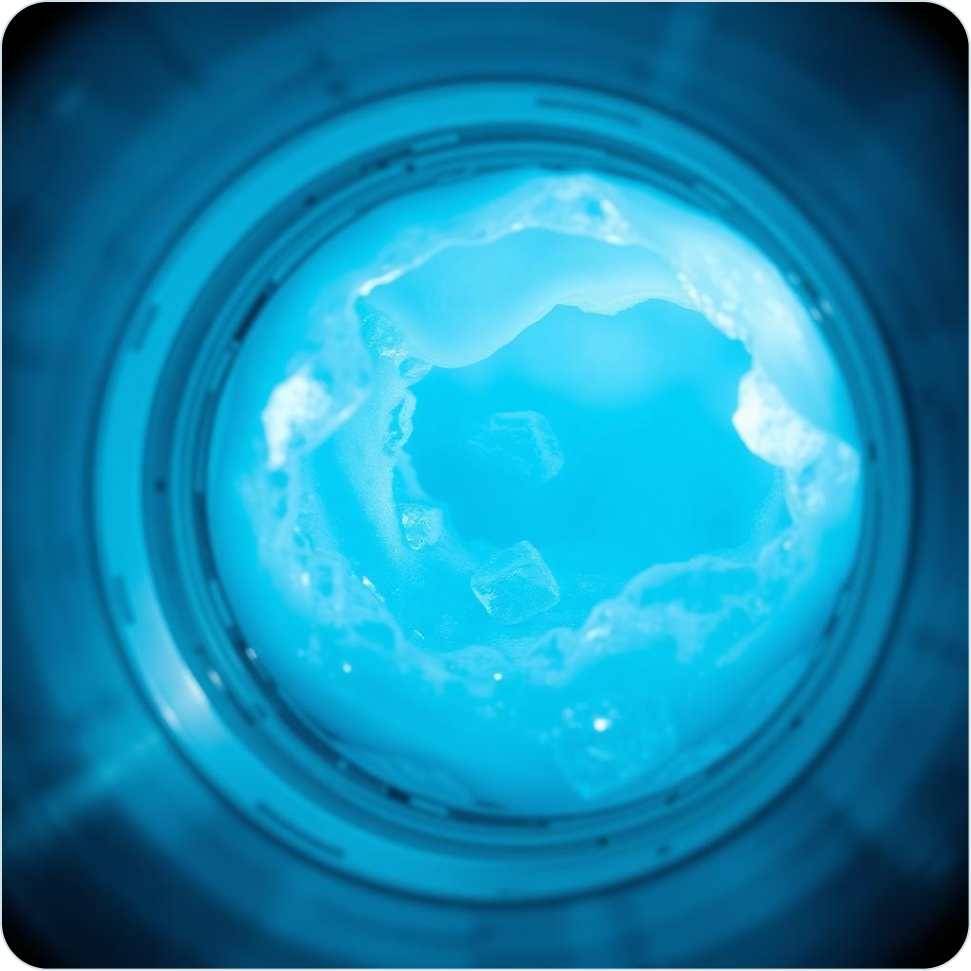
Ice pigging uses dense ice slurry to clean the inside of pipelines, moving like a soft plug to remove sediment, biofilm, grease, scale, and residue while passing through bends, valves, and changing pipe sizes where flushing or rigid pigging may be limited.
- In one sentence
Ice Pigging Uses Pumpable Ice To Clean The Inside Of A Pipeline
Instead of a solid foam or polyurethane pig — which can get stuck, damage fittings, or skip past bends — ice pigging uses a thick slurry of crushed ice mixed with a freezing-point depressant. The slurry behaves like a liquid when it needs to (going around bends, through valves, past instrumentation) and behaves like a solid when it counts (scouring the pipe wall).
Unlike a rigid foam or mechanical pig, the ice slurry can change shape as it moves. If movement stops, the ice can melt back into liquid, which helps reduce the risk of leaving a solid pig trapped in the line.

- The science
How Ice Slurry Cleans Like A Pig And Moves Like A Liquid
The cleaning performance comes from a few specific properties of an ice/brine mixture that no other cleaning method has all at once.
Two-Phase Slurry
Ice crystals are suspended in liquid so the slurry can move through complex pipe layouts.
Pipe-Wall Contact
The moving slurry creates cleaning force against buildup along the pipe wall.
Melt-Back Safety
If movement stops, the ice can melt instead of remaining as a rigid blockage.
Controlled Discharge
Removed material exits with the slurry and can be managed at the outlet.
- How it works
From Site Review To Verified Pipeline Cleaning
A typical ice pigging operation runs end-to-end in 1–4 hours, with the pipe back in service the same day.
01
Review The Pipeline
Pipe size, length, material, access points, pressure, and buildup type are reviewed.
02
Prepare The Slurry
The ice slurry is prepared based on the pipe conditions and cleaning goal.
03
Inject Through Access Point
The slurry is introduced through a suitable hydrant, valve, fitting, or access point.
04
Push, Scour, And Discharge
The ice moves through the pipe, loosens buildup, and carries it to the exit point.
05
Flush And Verify
The line is flushed, discharge is reviewed, and results are documented as needed.
- Why operators choose it
A Flexible Cleaning Method For Complex Pipeline Systems
Lower Stuck-Pig Risk
Ice can melt if movement stops, unlike a rigid mechanical pig.Period.
Less Excavation
Suitable projects can use existing valves, hydrants, fittings, or access points.
Lower Water Use
Direct wall contact can reduce the need for repeated high-volume flushing.
No Harsh Chemicals
Cleaning relies on physical ice slurry action instead of aggressive chemicals.
Hours, not days
Many projects can be planned around limited work windows.
Cleaner Flow Path
The slurry helps remove sediment, biofilm, grease, scale, and residue.
- Compared to alternatives
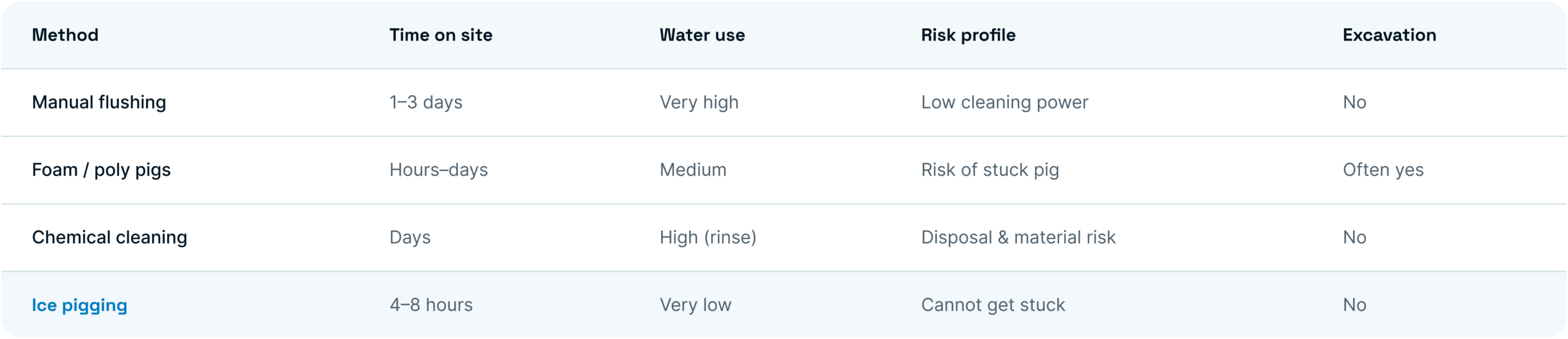
Where Ice Pigging Fits In The Pipeline Cleaning Toolkit
Used Across Water, Wastewater, And Industrial Pipeline Systems
- Remove sediment, biofilm, and discoloration-causing deposits from suitable mains.
- Help clear grease, grit, soft deposits, and flow restrictions.
- Support changeovers, residue removal, and product recovery.
- Clean product-contact lines with less chemical dependency.
- Remove scale, sediment, and corrosion-related buildup from thermal systems.
Ice Pigging Targets The Buildup That Restricts Flow And Quality
- Loose material that settles inside the pipe.
- Organic buildup that forms along internal surfaces.
- Fats, oils, grease, and soft restrictions in suitable lines.
- Mineral buildup, product residue, and process deposits.
- Iron, manganese, and related material that can affect water quality.
- Loosened material carried out with the ice slurry discharge.
- A short history
From University Research To Pipeline Cleaning Technology
Early Development
The concept was developed through University of Bristol research.
Food Industry Use
Early applications focused on product recovery and process pipe cleaning.
Water System Adoption
The method was later adapted for drinking water and utility maintenance.
Today
Ice pigging is used in municipal, utility, wastewater, and industrial systems.
- FAQ
Ice Pigging FAQs
What Is Ice Pigging In Simple Terms?
How Does Ice Pigging Clean A Pipe?
Is Ice Pigging Safe For Drinking Water Mains?
Can The Ice Get Stuck Inside The Pipe?
What Pipe Sizes Can Be Cleaned With Ice Pigging?
What Pipe Materials Can Ice Pigging Work With?
It can be evaluated for many common pipe materials, including ductile iron, cast iron, steel, PVC, HDPE, and stainless steel, depending on system condition.
Have a more specific question about your asset? Send us a pipe schedule and we’ll give you a feasibility answer within 24 hours.
Find Out If Ice Pigging Fits Your Pipeline
Share your pipe size, length, material, access points, project location, and buildup type. We’ll review the system and help determine whether ice pigging is a practical cleaning option.